 Aquarium Fish Guide
Build a tank / Fish / Coral beauty angelfish
Coral beauty angelfish
Centropyge bispinosa
The coral beauty is a dwarf angelfish about four inches long, with a deep blue head and fins and an orange to yellow body crossed by thin dark bars. It is one of the hardier and more affordable dwarf angels, and it spends the day picking at the rockwork. The catch is that some individuals nip at corals.
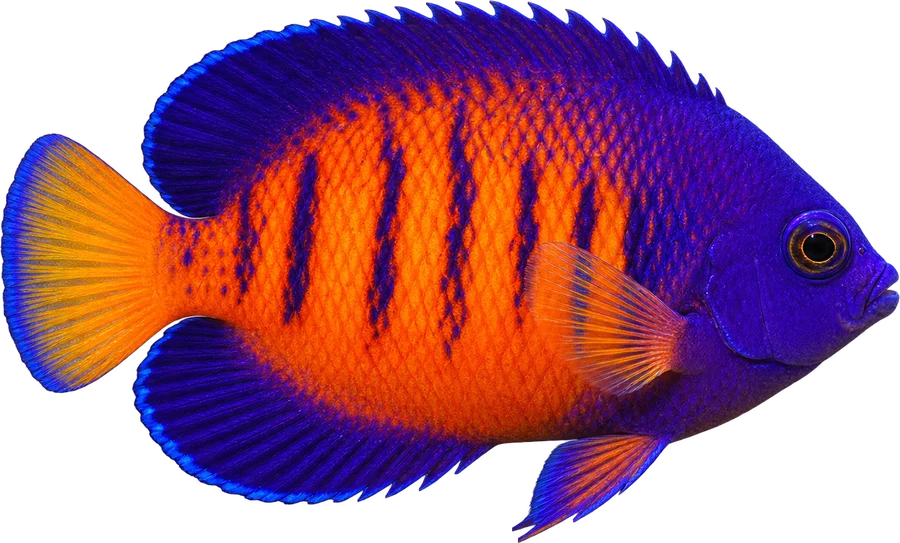
- Grows to
- 4 in
- Smallest tank
- 75 gallons
- Temperature
- 72 to 78°F
- Water
- Saltwater
- Swims
- Low in the tank
- Buy together
- One is fine
- Lives
- 5 to 10 years
- With tank mates
- Chases and nips
Is it right for you?
Better with some experience. The fish is hardy, but it needs a large, mature tank with plenty of rock, and its behavior toward corals is unpredictable.
It is semi-aggressive. It is usually fine with unrelated fish but territorial toward other dwarf angelfish and similar-shaped fish, and it can chase timid fish in a tight tank.
What keepers say
Keepers call the coral beauty a gamble that usually pays off. Most report a well-behaved, attractive fish that never touches coral, and a smaller group report one that began nipping, sometimes after months of good behavior.
What keepers like
- Many owners call theirs a model citizen and a favorite fish.
- It is widely seen as one of the dwarf angels least likely to bother corals or tank mates.
- It is hardy and can live for many years.
- It is always busy picking over the rocks, which makes it interesting to watch.
Good to know first
- Some individuals nip zoanthids, large-polyp stony corals or clams, and corals may stay closed while the fish is in the tank.
- A fish that behaved for six months or a year can start nipping without warning.
- A few owners found theirs to be a bully that chased other fish.
- Once it is established it is very hard to catch and remove.
Tips keepers repeat
- Feed it well and often, with seaweed and algae foods included, to lower the chance of coral nipping.
- Keep it in a larger, mature tank with plenty of algae-covered rock to graze.
- Have a plan for removing it, such as a fish trap or a sump, before adding it to a reef.
- Keeping prized zoanthids or clams with it is a risk that owners should accept up front.
Summarised from keeper discussion on reef2reef.com. Links are at the foot of the page.
What it needs
| Tank | 75 gallons or more. One per tank. |
|---|---|
| Water | 72 to 78°F, pH 8.1 to 8.4. Saltwater. Needs a heater in most homes. |
| Food | It grazes on algae growing on the rocks and should also be fed spirulina-based pellets or flakes, dried seaweed, and frozen mysis or brine shrimp. Two or three small feedings a day are recommended, partly to keep it from picking at corals. |
| Lifespan | 5 to 10 years with good care, so it is a long commitment. |
| Comes from | It lives on coral reefs across the Indo-Pacific, from East Africa to the Tuamotu Islands, including the Great Barrier Reef. |
One coral beauty angelfish is fine on its own. Of the standard tank sizes, the 75, 125, 180, 240 gallon tanks are big enough. Fish are counted at the size they grow to: a 4 inch adult takes far more room than the young fish in the store.
Who it can live with
Often kept with
- Clownfish
- Yellow tang
- Green chromis
- Cardinalfish
- Watchman gobies
- Tailspot blenny
Best kept apart from
- Other dwarf angelfish such as the flame angel, which it fights in most tanks
- Zoanthids, fleshy stony corals and clams, which some individuals nip
- Firefish and other timid fish in a small tank, which it may chase
- Lionfish and other large predators
Against the other fish on this site
- Chases and nips: royal gramma.
- No clash on size or temperature: ocellaris clownfish, blue hippo tang, yellow tang, firefish goby, banggai cardinalfish, six line wrasse, green mandarin goby, yellow watchman goby, yellowtail damselfish, green chromis.
That list is worked out from adult size and temperature alone. Individual fish vary, and a tank that is too small makes peaceful fish fight.
Where new owners go wrong
- Putting it in a small nano tank, where it becomes territorial.
- Adding it to a new tank with bare rock and nothing to graze.
- Keeping it with another dwarf angelfish in an average-sized tank.
- Assuming it is fully reef safe and adding it to a tank of expensive corals with no way to get it out.
At the store
What to look for, and ask, before one goes in the bag.
- Watch for a fish that is actively picking at rocks and swimming in and out of cover.
- Ask to see it eat prepared food, not only graze.
- Check for clear eyes, intact fins and no white spots or cloudy patches.
- Ask whether a captive-bred fish is available, since some are now sold.
What to buy for it
The smallest standard tank that suits it is the 75 gallon (48 x 18 x 21 inches), which weighs about 842 lb when full. It needs a heater in most homes. No real tank this large is listed here yet. Heaters and filters are not linked to products yet.
Paid links: the stand names below link to Amazon and earn the site a commission.
| Stand that fits a 75 gallon | Top | Rated load | Price, 23 Nov 2026 |
|---|---|---|---|
| GRLEAF 55 to 75 gallon stand | 49 x 19 in | 1000 lb | $118.99 |
| HOOBRO 75 gallon stand, two drawers | 52 x 19.7 in | 1146 lb | $103.99 |
| VOWNER 125 to 150 gallon stand with cabinet | 72.9 x 18.9 in | 2200 lb | $223.99 |
For the floor of the tank, sand and gravel shows how many pounds a 75 gallon takes. Stands compares every stand.
See it before you buy it
Put one coral beauty angelfish in a tank that is big enough, add the fish you were thinking of keeping with it, and watch what the tank says about stocking, temperature and who gets along.
Sources
Checked on 23 November 2026. Care references rate it reef safe only with caution, and one retailer says it is not a good reef dweller, while most keepers report no coral damage. Tank size advice is fairly consistent at 70 gallons, although some keepers house it in less.
- LiveAquaria: Coral Beauty Angelfish care reference
- Saltwater Aquarium Blog: Coral beauty angelfish care reference
- Wikipedia: Centropyge bispinosa care reference
- Reef2Reef thread: is a coral beauty in a reef worth it keeper discussion
- Reef2Reef thread on long-term reef safety of the coral beauty keeper discussion
Care figures here come from the references listed and can still be wrong or out of date. Individual fish and tanks vary. Check with the store and a second care reference before you buy. Terms.