 Aquarium Fish Guide
Build a tank / Fish / Six line wrasse
Six line wrasse
Pseudocheilinus hexataenia
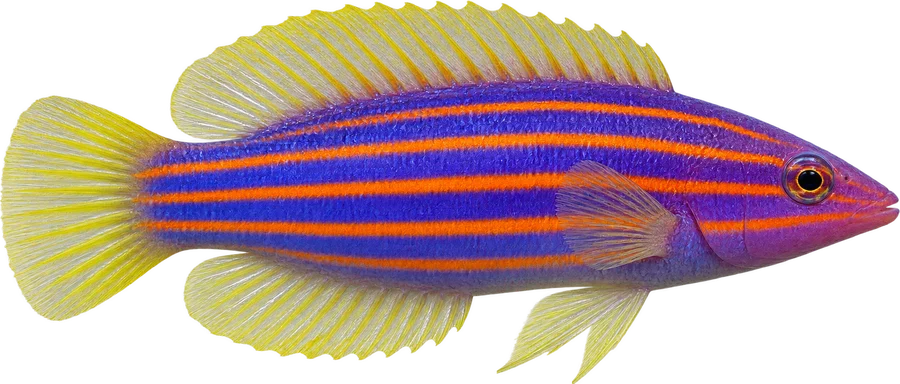
The six line wrasse is a three to four inch fish with six blue stripes running along an orange body. It weaves through the rockwork all day hunting tiny animals, and people often buy it to eat pests such as flatworms and bristleworms. It is hardy and cheap, but it has a reputation for turning into a bully.
- Grows to
- 4 in
- Smallest tank
- 55 gallons
- Temperature
- 72 to 78°F
- Water
- Saltwater
- Swims
- Low in the tank
- Buy together
- One is fine
- Lives
- 4 to 10 years
- With tank mates
- Chases and nips
Is it right for you?
Better with some experience. It is tough and easy to feed, but its aggression has to be planned around when choosing tank mates and the order they go in.
It is semi-aggressive. Young fish are usually calm, but adults can become territorial and pick on other wrasses, timid fish and anything added after them.
What keepers say
Keepers are sharply divided on the six line wrasse. Many have kept it for years with no trouble and call it a favorite, while others describe a fish that was peaceful at first and later attacked every new arrival, especially other wrasses.
What keepers like
- Owners enjoy its bold color and the way it hunts through the rocks all day.
- It is considered very hardy and long-lived.
- It eats pests such as flatworms and small bristleworms.
- It usually ignores very different fish such as clowns, tangs, gobies and blennies.
Good to know first
- It can turn on newly added fish, and other wrasses are the usual target.
- The aggression sometimes shows up only after months or years of good behavior.
- It is extremely hard to catch once it lives in the rockwork.
- It eats the small crustaceans in the tank that other fish, such as mandarins, depend on.
Tips keepers repeat
- Add it last, after all the other fish are settled, and do not plan to add more wrasses afterward.
- Give it a lot of rockwork with holes and breaks in the line of sight.
- Keep it well fed, since several keepers link bullying to hunger.
- Use a tight lid, because wrasses jump.
Summarised from keeper discussion on reef2reef.com. Links are at the foot of the page.
What it needs
| Tank | 55 gallons or more. One per tank. |
|---|---|
| Water | 72 to 78°F, pH 8.1 to 8.4. Saltwater. Needs a heater in most homes. |
| Food | It is a carnivore that hunts small crustaceans and worms on the rocks and should be fed frozen mysis and brine shrimp, finely chopped seafood and quality pellets. Regular feeding, two or three small meals a day, helps keep its temper down. |
| Lifespan | 4 to 10 years with good care, so it is a long commitment. |
| Comes from | It lives among coral branches on reefs across the Indo-Pacific, from the Red Sea and East Africa to Japan, Australia and the central Pacific. |
One six line wrasse is fine on its own. Of the standard tank sizes, the 55, 75, 125, 180 and larger gallon tanks are big enough. Fish are counted at the size they grow to: a 4 inch adult takes far more room than the young fish in the store.
Who it can live with
Often kept with
- Clownfish
- Tangs
- Dwarf angelfish
- Cardinalfish
- Blennies
- Larger, confident community fish
Best kept apart from
- Other wrasses, especially peaceful fairy, flasher and leopard wrasses, which it attacks
- Firefish and other timid fish, which it can harass to death
- Dottybacks, which have a similar shape and habits and fight with it
- Mandarin dragonets and other slow feeders, which compete with it for the same tiny prey
- Small ornamental crabs and shrimp, which some individuals pick at
Against the other fish on this site
- Chases and nips: royal gramma, firefish goby, green mandarin goby.
- No clash on size or temperature: ocellaris clownfish, blue hippo tang, yellow tang, banggai cardinalfish, coral beauty angelfish, yellow watchman goby, yellowtail damselfish, green chromis.
That list is worked out from adult size and temperature alone. Individual fish vary, and a tank that is too small makes peaceful fish fight.
Where new owners go wrong
- Adding it as one of the first fish in a tank that is meant to hold other wrasses or timid fish later.
- Buying it only for pest control without thinking about its long-term behavior.
- Keeping it with a mandarin dragonet in a tank with a limited supply of copepods.
- Leaving the tank uncovered.
At the store
What to look for, and ask, before one goes in the bag.
- Choose an alert fish that is actively moving through the rocks.
- Avoid a fish that is producing a lot of slime or has cloudy skin, which can point to a parasite infection.
- Ask to see it eat frozen or prepared food.
- Tell the store what you already keep and plan to add, and ask whether any of those fish are wrasses or timid species.
What to buy for it
The smallest standard tank that suits it is the 55 gallon (48 x 13 x 21 inches), which weighs about 598 lb when full. It needs a heater in most homes. No real tank this large is listed here yet. Heaters and filters are not linked to products yet.
Paid links: the stand names below link to Amazon and earn the site a commission.
| Stand that fits a 55 gallon | Top | Rated load | Price, 23 Nov 2026 |
|---|---|---|---|
| METYERRY 55 gallon stand | 48.6 x 13.6 in | 860 lb | $95.99 |
| GRLEAF 55 to 75 gallon stand | 49 x 19 in | 1000 lb | $118.99 |
| HOOBRO 75 gallon stand, two drawers | 52 x 19.7 in | 1146 lb | $103.99 |
For the floor of the tank, sand and gravel shows how many pounds a 55 gallon takes. Stands compares every stand.
See it before you buy it
Put one six line wrasse in a tank that is big enough, add the fish you were thinking of keeping with it, and watch what the tank says about stocking, temperature and who gets along.
Sources
Checked on 23 November 2026. Tank minimums range from 30 gallons to 55 or 60 gallons, sometimes within the same reference, and the larger figure is used here because more room and rock reduce aggression. Care references call it semi-aggressive, while keeper reports range from perfectly peaceful to highly aggressive.
- LiveAquaria: Six Line Wrasse care reference
- Saltwater Aquarium Blog: Six line wrasse care reference
- Wikipedia: Pseudocheilinus hexataenia care reference
- Reef2Reef thread: six line wrasse pros and cons keeper discussion
- Reef2Reef thread: experience with six line wrasse aggression keeper discussion
Care figures here come from the references listed and can still be wrong or out of date. Individual fish and tanks vary. Check with the store and a second care reference before you buy. Terms.