 Aquarium Fish Guide
Build a tank / Fish / Rosy red minnow
Rosy red minnow
Pimephales promelas
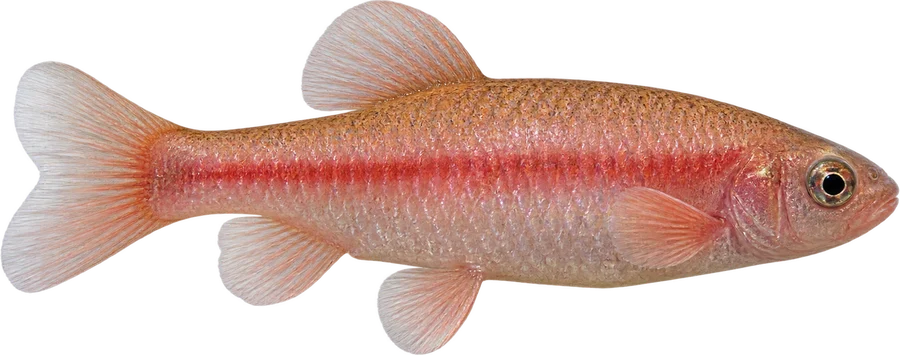
The rosy red is a pinkish orange color form of the fathead minnow, a small North American fish. It is usually sold very cheaply as a feeder fish, but it makes a hardy, peaceful pet that does not need a heater. People who keep it as a pet like its low price, its toughness and the way males guard a cave and eggs.
- Grows to
- 3 in
- Smallest tank
- 10 gallons
- Temperature
- 64 to 75°F
- Water
- Fresh water
- Swims
- The middle of the tank
- Buy together
- 6 or more
- Lives
- 2 to 4 years
- With tank mates
- Peaceful
Is it right for you?
Good for a first tank. It tolerates a wide range of temperatures and water conditions and eats almost anything, although fish from feeder tanks often arrive in poor health.
It is peaceful and active and stays with its group. Males chase each other and guard a nest site when breeding.
What keepers say
Keepers who treat rosy reds as pets describe them as an underrated, tough fish that is as hardy as a goldfish but far less messy. The main warning is about the feeder tanks they come from, where crowding means some fish arrive sick and die soon after purchase.
What keepers like
- Keepers describe them as very hardy, with pond fish surviving winters under ice.
- They do not need a heater, which keepers compare to white cloud minnows.
- Keepers see them as a cheap alternative to more expensive schooling fish, and they look good as a group in a larger tank.
- They breed readily, and keepers enjoy watching males guard eggs under a cave or pipe.
- Pond keepers like them for eating mosquito larvae and for being easy to see in dark water.
Good to know first
- A common complaint is that a share of newly bought fish die in the first days because feeder stock is crowded and poorly kept.
- Keepers report that males can become pushy and drive other fish away from a cave they have claimed.
- Babies rarely survive in a mixed tank because other fish eat them.
Tips keepers repeat
- Keepers advise keeping new fish apart for several weeks before adding them to an established tank, and say one week is not long enough.
- Keepers warn against crowding, with about 5 or 6 fish suggested as the limit for a 10 gallon tank.
- Extra water movement from an air stone or small pump is recommended because the fish do better with plenty of oxygen.
- A clay pot on its side or a short piece of plastic pipe gives a male a place to claim and spawn.
Summarised from keeper discussion on aquariacentral.com, monsterfishkeepers.com. Links are at the foot of the page.
What it needs
| Tank | 10 gallons or more. A group of 5 or 6 or more, with both males and females. |
|---|---|
| Water | 64 to 75°F, pH 7 to 8. Fresh water. |
| Food | It is an omnivore that eats flakes or small pellets, including goldfish food. Frozen bloodworms or brine shrimp and vegetables such as zucchini, cucumber or shelled peas make good extras. |
| Lifespan | 2 to 4 years with good care, so it is a long commitment. |
| Comes from | The wild fathead minnow lives in streams, ponds and lakes across North America from Canada to Mexico; the rosy red color form was bred in captivity. |
Rosy red minnows school. In ones and twos they hide and stress, so plan for six or more. Of the standard tank sizes, the 10, 15, 20, 29 and larger gallon tanks are big enough. Fish are counted at the size they grow to: a 3 inch adult takes far more room than the young fish in the store.
Who it can live with
Often kept with
- Ghost shrimp and Amano shrimp
- Dojo (weather) loaches
- Hillstream loaches
- Bristlenose plecos
- Mystery snails
- Goldfish too small to swallow them
Best kept apart from
- Large or aggressive fish, because rosy reds are small enough to be eaten
- Tropical fish that need steady warm water, because rosy reds do best cooler
- Baby shrimp, because the minnows may eat them
Against the other fish on this site
- Gets eaten by: comet goldfish, oscar, bala shark, jack dempsey.
- Wants different water temperature: betta (male), angelfish, pearl gourami, german blue ram, discus, boeseman's rainbowfish.
- No clash on size or temperature: fancy goldfish, white cloud minnow, neon tetra, zebra danio, guppy, bronze cory catfish, sunburst platy, red swordtail, tiger barb, cherry barb, black skirt tetra, harlequin rasbora, dwarf gourami, rainbow shark, otocinclus catfish, cardinal tetra, ember tetra, galaxy rasbora, pygmy cory catfish, bumblebee goby, hillstream loach, serpae tetra, black neon tetra, congo tetra, panda cory catfish, common pleco, pictus catfish, dalmatian molly, cherry shrimp, mystery snail.
That list is worked out from adult size and temperature alone. Individual fish vary, and a tank that is too small makes peaceful fish fight.
Where new owners go wrong
- Adding fish straight from a feeder tank to an established aquarium without a quarantine period.
- Packing dozens into a small tank because they are cheap, which leads to poor water and deaths.
- Keeping only one or two, when they are group fish that are bolder and more active together.
- Mixing them with large fish that see them as food.
At the store
What to look for, and ask, before one goes in the bag.
- Pick active fish with good color that come to the front for food.
- Look at the whole tank and walk away if many fish are dead, gasping or covered in white spots.
- Set up a separate quarantine tank before buying, since about four weeks apart from other fish is recommended for feeder stock.
- Buy a few more than planned, because early losses from feeder stock are common.
What to buy for it
The smallest standard tank that suits it is the 10 gallon (20 x 10 x 12 inches), which weighs about 109 lb when full. It does not need a heater in a normally warm room. A real tank that is big enough: Aqueon 20 Gallon Long, 20 gallons, $99.99 on Amazon on 22 Nov 2026 (paid link). Heaters and filters are not linked to products yet.
Paid links: the stand names below link to Amazon and earn the site a commission.
| Stand that fits a 10 gallon | Top | Rated load | Price, 23 Nov 2026 |
|---|---|---|---|
| Snughome 10 to 20 gallon stand, two shelves | 24 x 11.8 in | 350 lb | $33.24 |
| MAHANCRIS 10 gallon stand with cabinet | 23.6 x 11.8 in | 450 lb | $53.99 |
| Bestier 20 to 37 gallon stand | 30.7 x 13.8 in | 400 lb | $71.39 |
For the floor of the tank, sand and gravel shows how many pounds a 10 gallon takes. Stands compares every stand.
See it before you buy it
Put 6 rosy red minnows in a tank that is big enough, add the fish you were thinking of keeping with them, and watch what the tank says about stocking, temperature and who gets along.
Sources
Checked on 23 November 2026. References agree on a 10 gallon minimum for a small group, but one notes adults can reach 4 inches and asks for a spacious tank, so a larger tank is the safer choice. Stated survivable temperatures run from 50 degrees Fahrenheit up to about 82, while the comfortable range given for a home tank is narrower.
- Aquarium Source: Rosy red minnows care guide care reference
- Fishkeeping World: The complete guide to rosy red minnows care care reference
- Maidenhead Aquatics: Rosy minnow (Pimephales promelas) care reference
- AquariaCentral forum: rosy red minnows discussion thread keeper discussion
- AquariaCentral forum: member write-up on keeping and breeding rosy red minnows keeper discussion
- Monster Fish Keepers forum thread on rosy red care keeper discussion
Care figures here come from the references listed and can still be wrong or out of date. Individual fish and tanks vary. Check with the store and a second care reference before you buy. Terms.