 Aquarium Fish Guide
Build a tank / Fish / Harlequin rasbora
Harlequin rasbora
Trigonostigma heteromorpha
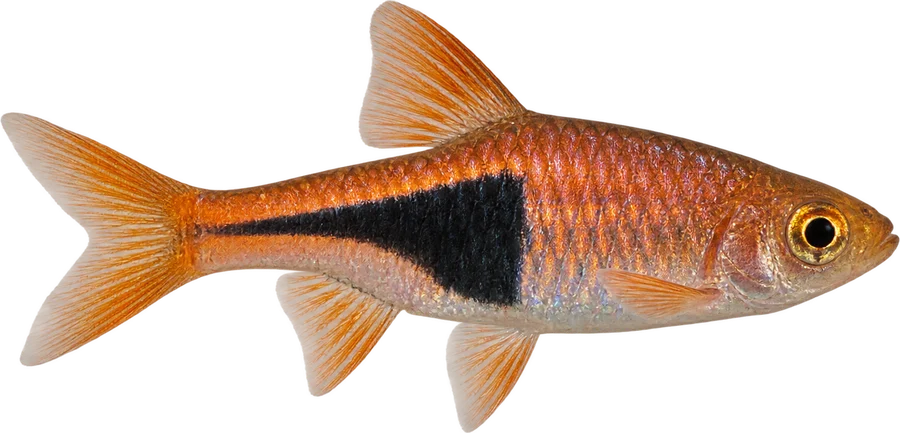
The harlequin rasbora is a small schooling fish from Southeast Asia with a coppery body and a dark triangular patch toward the tail. It is one of the classic beginner community fish because it is peaceful, hardy and active in a group. A school of them suits a planted tank especially well.
- Grows to
- 2 in
- Smallest tank
- 15 gallons
- Temperature
- 72 to 81°F
- Water
- Fresh water
- Swims
- Near the top
- Buy together
- 6 or more
- Lives
- 5 to 8 years
- With tank mates
- Peaceful
Is it right for you?
Good for a first tank. It is hardy once settled, peaceful with everything and happy on ordinary foods.
It is very peaceful and a little timid. It may dart away when someone walks up to the tank.
What keepers say
Keepers are fond of harlequin rasboras and most call them hardy, peaceful and trouble free. The cautions are that new arrivals can be delicate for the first days, that they school loosely unless the group is large, and that an established group occasionally suffers unexplained losses after new fish are added.
What keepers like
- Keepers say they have never seen them nip fins, even with angelfish and other long-finned fish.
- Keepers describe them as among the most active fish in the tank.
- Many keepers find them hardier than neon tetras once settled.
- Keepers like that good food and decent lighting bring out stronger color.
Good to know first
- Some keepers find them sensitive during the first days in a new tank.
- Keepers report occasional die-offs in established groups with no visible symptoms, often after a new fish was added.
- A few keepers find them a little dull in behavior, since they mostly swim back and forth.
Tips keepers repeat
- Keepers recommend a bigger school, with 8 to 12 often mentioned, for better schooling and bolder fish.
- Keepers advise slow, careful acclimation when bringing them home.
- Keepers suggest quarantining any new fish before it joins an established group.
- Keepers say occasional pushing within the group is just a pecking order and settles down in a bigger school.
Summarised from keeper discussion on aquariacentral.com. Links are at the foot of the page.
What it needs
| Tank | 15 gallons or more. A school of 8 to 10 or more. |
|---|---|
| Water | 72 to 81°F, pH 6 to 7.5. Fresh water. Needs a heater in most homes. |
| Food | It eats flakes and small granules readily. Small live or frozen foods such as daphnia, brine shrimp and bloodworms improve its color and condition. |
| Lifespan | 5 to 8 years with good care, so it is a long commitment. |
| Comes from | It comes from soft, slow, tea-colored forest streams in Peninsular Malaysia, Singapore and Sumatra. |
Harlequin rasboras school. In ones and twos they hide and stress, so plan for six or more. Of the standard tank sizes, the 15, 20, 29, 40 and larger gallon tanks are big enough. Fish are counted at the size they grow to: a 2 inch adult takes far more room than the young fish in the store.
Who it can live with
Often kept with
- Neon and cardinal tetras
- Corydoras catfish
- Kuhli loaches
- Bettas
- Other small rasboras
- Dwarf cichlids
Best kept apart from
- Bala sharks and other large fish, which eat small rasboras as they grow
- Large cichlids, which treat them as food
- Tiger barbs, which harass timid fish
- Hard-water fish such as African cichlids, because the water needs do not match
Against the other fish on this site
- Gets eaten by: comet goldfish, fancy goldfish, oscar, bala shark, convict cichlid, jack dempsey.
- Wants different water temperature: german blue ram.
- No clash on size or temperature: rosy red minnow, neon tetra, zebra danio, guppy, betta (male), angelfish, bronze cory catfish, bristlenose pleco, black molly, sunburst platy, red swordtail, tiger barb, cherry barb, black skirt tetra, dwarf gourami, kuhli loach, yellow lab cichlid, rainbow shark, otocinclus catfish, clown loach, cardinal tetra, ember tetra, galaxy rasbora, endler livebearer, pygmy cory catfish, bumblebee goby, hillstream loach, glowlight tetra, rummy nose tetra, serpae tetra, black neon tetra, congo tetra, pearl gourami, honey gourami, blue gourami, kribensis, firemouth cichlid, discus, panda cory catfish, common pleco, siamese algae eater, pictus catfish, dalmatian molly, cherry shrimp, mystery snail.
That list is worked out from adult size and temperature alone. Individual fish vary, and a tank that is too small makes peaceful fish fight.
Where new owners go wrong
- New owners buy three or four, which leaves the fish stressed and hiding.
- New owners rush them from the bag into the tank instead of acclimating them slowly.
- New owners keep them in very hard, alkaline water set up for livebearers or African cichlids.
- New owners add new, unquarantined fish to a long-settled group.
At the store
What to look for, and ask, before one goes in the bag.
- Look for a clear, dark triangle and a warm body color, and skip pale fish that hang apart from the group.
- Buy the full school at once.
- Ask how long the fish have been in the store, since ones that have been there a week or more have already survived the riskiest period.
- Check that the fish are true harlequins, because similar slimmer rasboras are sold under close names.
What to buy for it
The smallest standard tank that suits it is the 15 gallon (24 x 12 x 12 inches), which weighs about 160 lb when full. It needs a heater in most homes. A real tank that is big enough: Aqueon 20 Gallon Long, 20 gallons, $99.99 on Amazon on 22 Nov 2026 (paid link). Heaters and filters are not linked to products yet.
Paid links: the stand names below link to Amazon and earn the site a commission.
| Stand that fits a 15 gallon | Top | Rated load | Price, 23 Nov 2026 |
|---|---|---|---|
| Bestier 20 to 37 gallon stand | 30.7 x 13.8 in | 400 lb | $71.39 |
| POKIPO 20 to 29 gallon stand, slide-out shelf | 31.5 x 15.8 in | 770 lb | $93.49 |
| TOCRETOARE 40 gallon metal stand | 36.5 x 18.5 in | 660 lb | $69.99 |
For the floor of the tank, sand and gravel shows how many pounds a 15 gallon takes. Stands compares every stand.
See it before you buy it
Put 6 harlequin rasboras in a tank that is big enough, add the fish you were thinking of keeping with them, and watch what the tank says about stocking, temperature and who gets along.
Sources
Checked on 23 November 2026. References give the minimum tank as 10 gallons for six fish or as a 24 inch tank of about 14 gallons, and the larger figure is used here. The suggested minimum group ranges from 6 to 10.
- Seriously Fish: Trigonostigma heteromorpha care reference
- Aquarium Co-Op: Care Guide for Harlequin Rasboras and Lambchop Rasboras care reference
- Wikipedia: Harlequin rasbora care reference
- Aquaria Central forum thread: Harlequin rasboras vs black neon tetras keeper discussion
- Aquaria Central forum thread: Are Harlequin Rasboras fin nippers? keeper discussion
- Aquaria Central forum thread on harlequin rasboras dying keeper discussion
Care figures here come from the references listed and can still be wrong or out of date. Individual fish and tanks vary. Check with the store and a second care reference before you buy. Terms.