 Aquarium Fish Guide
Build a tank / Fish / Serpae tetra
Serpae tetra
Megalamphodus eques
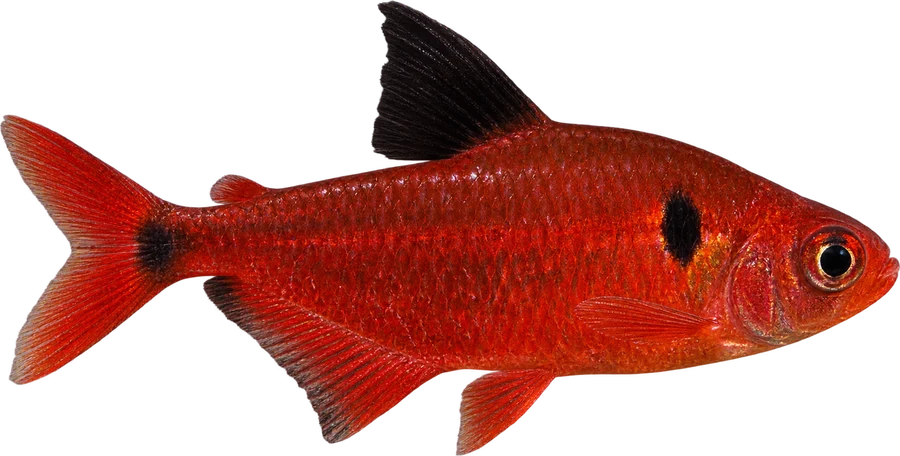
The serpae tetra is a deep-bodied, blood red tetra with a black mark behind the gills and a black dorsal fin. It was long known as Hyphessobrycon eques and is also sold as the red minor, jewel or callistus tetra. It is cheap, tough and eye-catching in a planted tank, and it is also one of the best known fin nippers among small tetras.
- Grows to
- 1.75 in
- Smallest tank
- 20 gallons
- Temperature
- 72 to 79°F
- Water
- Fresh water
- Swims
- The middle of the tank
- Buy together
- 6 or more
- Lives
- 5 to 7 years
- With tank mates
- Chases and nips
Is it right for you?
Good for a first tank. It is hardy and easy to feed, and the real challenge is choosing tank mates that can live with its nipping.
It is lively and pushy, with constant sparring inside the school over rank. It nips the fins of slow or long-finned tank mates, and this is worst in small groups and small tanks.
What keepers say
Keepers are split on serpae tetras. Many report relentless fin nipping that ended with damaged or dead angelfish and gouramis, while others have kept large schools in big tanks with no trouble at all. Most agree that school size, tank size and feeding decide how they behave.
What keepers like
- Keepers like the deep red color, which stands out against green plants.
- Keepers with a big school in a large tank describe a lively group that mostly squabbles among itself.
- Keepers find them sturdy enough to live with small to medium cichlids that would bully gentler tetras.
- Keepers note that chasing inside a new group usually calms down within days as a pecking order forms.
Good to know first
- A common complaint is constant harassment of angelfish, which end up hiding with ragged fins.
- Keepers report losing gouramis and angelfish to nipping in small tanks.
- Some keepers found that a group of six still nipped in a mid-sized tank, and they ended up returning the fish.
- Keepers say the school loosens once the fish settle in, so it does not always swim as a tight group.
Tips keepers repeat
- Keepers recommend a large school, with ten or more often given as the number at which nipping drops.
- Keepers say nipping eases in tanks larger than about 29 gallons.
- Keepers suggest feeding well, including protein-rich foods, since hungry serpaes nip more.
- Keepers advise leaving out long-finned fish altogether instead of hoping a big school will protect them.
Summarised from keeper discussion on aquariacentral.com, monsterfishkeepers.com. Links are at the foot of the page.
What it needs
| Tank | 20 gallons or more. A school of 6 at the very least, and 12 or more to keep fin nipping down. |
|---|---|
| Water | 72 to 79°F, pH 5 to 7.5. Fresh water. Needs a heater in most homes. |
| Food | It is an omnivore that does well on good flakes or small pellets. Regular frozen or live foods such as bloodworms, daphnia and brine shrimp keep it in color and seem to make it less nippy. |
| Lifespan | 5 to 7 years with good care, so it is a long commitment. |
| Comes from | It comes from still and slow-moving waters of the Amazon and Paraguay river basins in Brazil, Peru, Bolivia, Paraguay and Argentina. |
Serpae tetras school. In ones and twos they hide and stress, so plan for six or more. Of the standard tank sizes, the 20, 29, 40, 55 and larger gallon tanks are big enough. Fish are counted at the size they grow to: a 1.75 inch adult takes far more room than the young fish in the store.
Who it can live with
Often kept with
- Black skirt tetras and other robust tetras
- Fast danios
- Corydoras catfish
- Bristlenose plecos
- Bolivian rams and other sturdy small cichlids
- Swordtails
Best kept apart from
- Angelfish, because their long fins get shredded
- Bettas, for the same reason
- Fancy guppies, which are slow and long-tailed
- Gouramis, whose feelers and fins get nipped
- Large predatory fish, which eat tetras this size
Against the other fish on this site
- Gets eaten by: comet goldfish, fancy goldfish, angelfish, oscar, bala shark, convict cichlid, jack dempsey, firemouth cichlid, pictus catfish.
- Chases and nips: guppy, betta (male), angelfish, pearl gourami, honey gourami.
- Wants different water temperature: german blue ram, boeseman's rainbowfish.
- No clash on size or temperature: rosy red minnow, neon tetra, zebra danio, bronze cory catfish, bristlenose pleco, black molly, sunburst platy, red swordtail, tiger barb, cherry barb, black skirt tetra, harlequin rasbora, dwarf gourami, kuhli loach, yellow lab cichlid, rainbow shark, otocinclus catfish, clown loach, cardinal tetra, ember tetra, galaxy rasbora, endler livebearer, pygmy cory catfish, bumblebee goby, hillstream loach, glowlight tetra, rummy nose tetra, black neon tetra, congo tetra, blue gourami, kribensis, panda cory catfish, common pleco, siamese algae eater, dalmatian molly, cherry shrimp, mystery snail.
That list is worked out from adult size and temperature alone. Individual fish vary, and a tank that is too small makes peaceful fish fight.
Where new owners go wrong
- New owners buy three or four for a 10 gallon tank, which is the setup where nipping is at its worst.
- New owners add them to a tank with a betta, angelfish or fancy guppies.
- New owners assume every small tetra is a gentle community fish and do not ask about this one's reputation.
- New owners underfeed them, which keepers link to more nipping.
At the store
What to look for, and ask, before one goes in the bag.
- Buy the whole school in one visit so the fish sort out their ranking together.
- Check the fins of every fish in the tank, since serpaes nip each other and badly torn fish are best skipped.
- Tell the store what fish are already at home and ask plainly whether serpaes will nip them.
- Decide between standard and long-finned forms, because long-finned serpaes are more likely to be nipped themselves.
What to buy for it
The smallest standard tank that suits it is the 20 gallon (24 x 12 x 16 inches), which weighs about 211 lb when full. It needs a heater in most homes. A real tank that is big enough: Aqueon 20 Gallon Long, 20 gallons, $99.99 on Amazon on 22 Nov 2026 (paid link). Heaters and filters are not linked to products yet.
Paid links: the stand names below link to Amazon and earn the site a commission.
| Stand that fits a 20 gallon | Top | Rated load | Price, 23 Nov 2026 |
|---|---|---|---|
| Bestier 20 to 37 gallon stand | 30.7 x 13.8 in | 400 lb | $71.39 |
| POKIPO 20 to 29 gallon stand, slide-out shelf | 31.5 x 15.8 in | 770 lb | $93.49 |
| TOCRETOARE 40 gallon metal stand | 36.5 x 18.5 in | 660 lb | $69.99 |
For the floor of the tank, sand and gravel shows how many pounds a 20 gallon takes. Stands compares every stand.
See it before you buy it
Put 6 serpae tetras in a tank that is big enough, add the fish you were thinking of keeping with them, and watch what the tank says about stocking, temperature and who gets along.
Sources
Checked on 23 November 2026. References disagree on group size, from five to seven fish up to at least 12, and the larger number is given here as the safer target. Some also accept a 10 gallon tank, while the most cautious calls about 19 gallons the absolute minimum. Keepers themselves disagree on how nippy the fish really is.
- Seriously Fish: Megalamphodus eques (formerly Hyphessobrycon eques) care reference
- Wikipedia: Serpae tetra care reference
- Aquarium Source: serpae tetra care care reference
- Aquaria Central forum thread: Serpae Tetra Compatibility Problems keeper discussion
- Aquaria Central forum thread: Angelfish and Serpae tetras, a good idea? keeper discussion
- Aquaria Central forum thread on red serpae tetras chasing each other keeper discussion
- Monster Fish Keepers forum thread: Serpae or White Skirt tetras with cichlids? keeper discussion
Care figures here come from the references listed and can still be wrong or out of date. Individual fish and tanks vary. Check with the store and a second care reference before you buy. Terms.