 Aquarium Fish Guide
Build a tank / Fish / Cardinal tetra
Cardinal tetra
Paracheirodon axelrodi
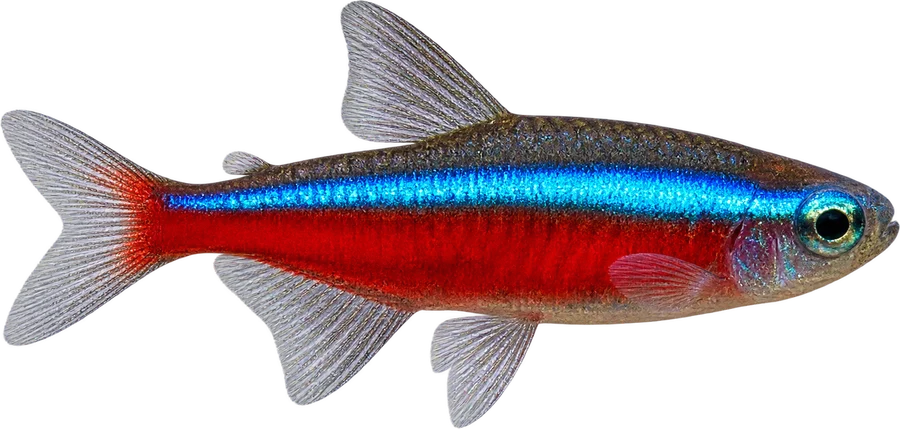
The cardinal tetra is a small schooling fish from South America with a glowing blue line above a red stripe that runs the full length of its body. It looks like a larger, brighter neon tetra, and a big school of them is one of the classic sights of a planted tank. It likes warmer, softer water than most small tetras and can be touchy in its first weeks at home.
- Grows to
- 1.75 in
- Smallest tank
- 20 gallons
- Temperature
- 73 to 84°F
- Water
- Fresh water
- Swims
- The middle of the tank
- Buy together
- 6 or more
- Lives
- 4 to 5 years
- With tank mates
- Peaceful
Is it right for you?
Better with some experience. Many are still wild caught and are sensitive to poor or changing water while they settle in, although they are sturdy once established.
It is peaceful and a little shy, and it feels safest in a large group with plants and dim light.
What keepers say
Keepers love the color of a big school and many say cardinals are tough once they have settled. The hard part is the first days and weeks, when losses are common. Keepers blame rough shipping, poorly kept store stock, fast acclimation and water that is much harder and more alkaline than the fish are used to.
What keepers like
- Keepers like the bright red and blue color, which shows best in a large school.
- Keepers say cardinals are hardy once they are past the settling-in period.
- Keepers like that they handle the warmer water needed by fish such as discus and rams.
- Some keepers report cardinals living six years or more.
Good to know first
- A common complaint is losing fish in the first days or weeks after purchase.
- Keepers say store stock often arrives stressed or carrying parasites after a long supply chain.
- Keepers report ich outbreaks when new cardinals go straight into an established tank.
- Some keepers say cardinals are not a good choice for a beginner or for a small, unstable tank.
Tips keepers repeat
- Keepers say to acclimate them slowly to the new water.
- Keepers recommend watching the fish in the store for a week or two before buying and choosing ones with clean fins and skin.
- Keepers advise quarantining new cardinals before adding them to a main tank.
- Keepers suggest dim light, leaf litter or other sources of tannins, and small foods like baby brine shrimp for the first days.
Summarised from keeper discussion on monsterfishkeepers.com, aquariacentral.com. Links are at the foot of the page.
What it needs
| Tank | 20 gallons or more. A school of 8 to 10 or more. |
|---|---|
| Water | 73 to 84°F, pH 4 to 7.5. Fresh water. Needs a heater in most homes. |
| Food | It eats any small food that fits in its mouth, such as crushed flakes and tiny pellets. It does best when that is mixed with frozen or live foods like daphnia, baby brine shrimp and bloodworms. |
| Lifespan | 4 to 5 years with good care, so it is a long commitment. |
| Comes from | It comes from the Rio Negro and Orinoco river systems of Brazil, Colombia and Venezuela, where the water is soft and acidic. |
Cardinal tetras school. In ones and twos they hide and stress, so plan for six or more. Of the standard tank sizes, the 20, 29, 40, 55 and larger gallon tanks are big enough. Fish are counted at the size they grow to: a 1.75 inch adult takes far more room than the young fish in the store.
Who it can live with
Often kept with
- Corydoras catfish
- Pencilfish
- Hatchetfish
- Otocinclus catfish
- German blue rams
- Kuhli loaches
Best kept apart from
- Large angelfish or discus with small young cardinals, which can be eaten
- Any fish big enough to swallow them
- Boisterous or aggressive fish, which keep them stressed and hiding
- Baby shrimp, which they may eat
Against the other fish on this site
- Gets eaten by: comet goldfish, fancy goldfish, angelfish, oscar, bala shark, convict cichlid, jack dempsey, firemouth cichlid, pictus catfish.
- Wants different water temperature: white cloud minnow.
- No clash on size or temperature: rosy red minnow, neon tetra, zebra danio, guppy, betta (male), bronze cory catfish, bristlenose pleco, black molly, sunburst platy, red swordtail, tiger barb, cherry barb, black skirt tetra, harlequin rasbora, dwarf gourami, kuhli loach, yellow lab cichlid, rainbow shark, otocinclus catfish, clown loach, ember tetra, galaxy rasbora, endler livebearer, pygmy cory catfish, bumblebee goby, hillstream loach, glowlight tetra, rummy nose tetra, serpae tetra, black neon tetra, congo tetra, pearl gourami, honey gourami, blue gourami, german blue ram, kribensis, discus, panda cory catfish, common pleco, siamese algae eater, boeseman's rainbowfish, dalmatian molly, cherry shrimp, mystery snail.
That list is worked out from adult size and temperature alone. Individual fish vary, and a tank that is too small makes peaceful fish fight.
Where new owners go wrong
- New owners often add them to a tank that is only a few weeks old and still unstable.
- New owners often buy just three or four, which leaves them nervous and pale.
- New owners often pour them straight into the tank without slow acclimation.
- New owners often keep them in hard, alkaline water without checking, which wild-caught fish handle poorly.
At the store
What to look for, and ask, before one goes in the bag.
- Check that the red stripe runs the full length of the body, since neon tetras are sometimes mixed in or mislabeled.
- Look for full, undamaged fins, bright color and no white spots.
- Ask how long the fish have been in the store, because newly arrived stock is the most likely to die.
- Ask whether the fish are wild caught or tank raised, since tank-raised ones tend to adapt more easily.
What to buy for it
The smallest standard tank that suits it is the 20 gallon (24 x 12 x 16 inches), which weighs about 211 lb when full. It needs a heater in most homes. A real tank that is big enough: Aqueon 20 Gallon Long, 20 gallons, $99.99 on Amazon on 22 Nov 2026 (paid link). Heaters and filters are not linked to products yet.
Paid links: the stand names below link to Amazon and earn the site a commission.
| Stand that fits a 20 gallon | Top | Rated load | Price, 23 Nov 2026 |
|---|---|---|---|
| Bestier 20 to 37 gallon stand | 30.7 x 13.8 in | 400 lb | $71.39 |
| POKIPO 20 to 29 gallon stand, slide-out shelf | 31.5 x 15.8 in | 770 lb | $93.49 |
| TOCRETOARE 40 gallon metal stand | 36.5 x 18.5 in | 660 lb | $69.99 |
For the floor of the tank, sand and gravel shows how many pounds a 20 gallon takes. Stands compares every stand.
See it before you buy it
Put 6 cardinal tetras in a tank that is big enough, add the fish you were thinking of keeping with them, and watch what the tank says about stocking, temperature and who gets along.
Sources
Checked on 23 November 2026. References give minimum tank sizes from about 14 to 20 gallons for a school, and the 20 gallon figure is used here. Lifespan is usually given as 4 to 5 years, though some keepers report longer.
- Seriously Fish: Paracheirodon axelrodi care reference
- Aquarium Co-Op: cardinal tetra care guide care reference
- Wikipedia: Cardinal tetra care reference
- Aquarium Source: cardinal tetra care care reference
- Monster Fish Keepers thread on why cardinals and neons die so often keeper discussion
- Aquaria Central thread on cardinal tetras keeper discussion
Care figures here come from the references listed and can still be wrong or out of date. Individual fish and tanks vary. Check with the store and a second care reference before you buy. Terms.