 Aquarium Fish Guide
Build a tank / Fish / Guppy
Guppy
Poecilia reticulata
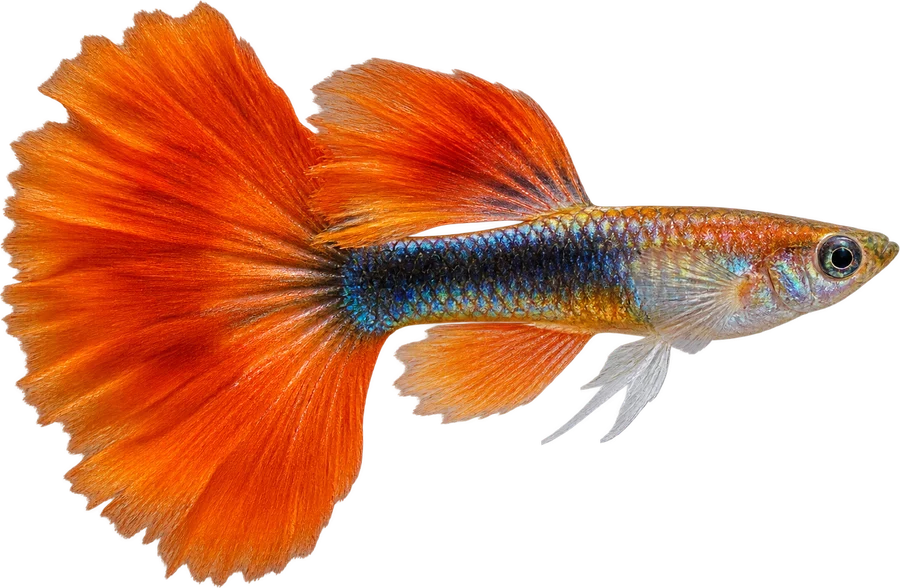
The guppy is a small livebearing fish from northeastern South America and the southern Caribbean. Males are about an inch and a half long with brightly colored, fan-shaped tails, while females are larger and plainer. It is popular because it is colorful, cheap, always on the move and gives birth to live babies that are easy to raise.
- Grows to
- 2 in
- Smallest tank
- 10 gallons
- Temperature
- 72 to 80°F
- Water
- Fresh water
- Swims
- Near the top
- Buy together
- 3 or more
- Lives
- 2 to 3 years
- With tank mates
- Peaceful
Is it right for you?
Good for a first tank. It is easy to feed and breed and suits hard tap water, although mass-bred store fish can be weak and it struggles in soft, acidic water.
It is very peaceful and active. Males chase females constantly and may nip at each other or at other fish with showy fins.
What keepers say
Keepers enjoy guppies but often say the easy reputation no longer fits store-bought fish. Losses soon after purchase are a frequent topic, and keepers blame mass breeding, inbreeding and shipping stress. Fish born and raised in the keeper's own tank are widely reported to be much tougher.
What keepers like
- Keepers like the color and constant activity for the low price.
- Healthy guppies produce plenty of babies, which keepers find rewarding to raise.
- Keepers report that guppies born in their own tank are noticeably hardier than the fish they bought.
- Guppies from local hobby breeders or carefully run stores are praised as far healthier than bulk stock.
Good to know first
- A common complaint is new guppies wasting away or dying one after another while other species in the same tank stay healthy.
- Keepers say fancy, big-tailed strains are more fragile and more inbred than plainer fish.
- Quality varies from shipment to shipment, even at the same store.
- Keepers report that mildly aggressive tank mates stress guppies badly.
Tips keepers repeat
- Keepers advise at least two females per male so that one female is not harassed.
- Dense plants such as java moss are recommended so babies have somewhere to hide.
- Keepers suggest slow drip acclimation and a quarantine period of a week or two for new fish.
- Testing for soft water and adding minerals if needed is advised, since guppies prefer hard water.
Summarised from keeper discussion on aquariacentral.com, monsterfishkeepers.com. Links are at the foot of the page.
What it needs
| Tank | 10 gallons or more. A small group, with two or three females for each male, or males only to avoid babies. |
|---|---|
| Water | 72 to 80°F, pH 7 to 8.5. Fresh water. Needs a heater in most homes. |
| Food | It eats flakes and small pellets and enjoys frozen or live foods such as brine shrimp, daphnia and bloodworms. It also picks at algae, so some plant-based food is useful. |
| Lifespan | 2 to 3 years with good care, so it is a long commitment. |
| Comes from | It is native to Venezuela, Guyana, Trinidad and Tobago and nearby parts of northeastern South America and the Caribbean, and has been introduced around the world. |
Guppies are usually bought in a small group of about 3. Of the standard tank sizes, the 10, 15, 20, 29 and larger gallon tanks are big enough. Fish are counted at the size they grow to: a 2 inch adult takes far more room than the young fish in the store.
Who it can live with
Often kept with
- Corydoras catfish
- Platies and other peaceful livebearers
- Neon tetras and other small peaceful tetras
- Rasboras
- Small plecos such as the bristlenose
Best kept apart from
- Tiger barbs and serpae tetras, because they nip the long tails
- Male bettas, because many attack fish with colorful flowing fins
- Angelfish and other larger fish, because guppies and their babies get eaten
- Bala sharks and other large active fish, because they outgrow and bully small fish
Against the other fish on this site
- Gets eaten by: comet goldfish, fancy goldfish, oscar, bala shark, convict cichlid, jack dempsey.
- Gets nipped by: betta (male), tiger barb, black skirt tetra, yellow lab cichlid, serpae tetra, convict cichlid, firemouth cichlid.
- Wants different water temperature: german blue ram, boeseman's rainbowfish.
- No clash on size or temperature: rosy red minnow, neon tetra, zebra danio, angelfish, bronze cory catfish, bristlenose pleco, black molly, sunburst platy, red swordtail, cherry barb, harlequin rasbora, dwarf gourami, kuhli loach, rainbow shark, otocinclus catfish, clown loach, cardinal tetra, ember tetra, galaxy rasbora, endler livebearer, pygmy cory catfish, bumblebee goby, hillstream loach, glowlight tetra, rummy nose tetra, black neon tetra, congo tetra, pearl gourami, honey gourami, blue gourami, kribensis, panda cory catfish, common pleco, siamese algae eater, pictus catfish, dalmatian molly, cherry shrimp, mystery snail.
That list is worked out from adult size and temperature alone. Individual fish vary, and a tank that is too small makes peaceful fish fight.
Where new owners go wrong
- Mixing males and females without a plan for the dozens of babies that follow every month.
- Keeping one female with several males, which leaves her chased to exhaustion.
- Keeping guppies in soft, acidic water where they slowly decline.
- Adding new store fish straight to an established tank without a quarantine period.
At the store
What to look for, and ask, before one goes in the bag.
- Choose active fish with fins held open, and avoid any that shimmy in place, clamp their fins or look thin.
- Skip a tank that has dead or sick fish in it, even if the one you like looks fine.
- Decide between males only and a mixed group before buying, since females from mixed tanks are almost always already pregnant.
- Ask where the fish came from, because locally bred guppies tend to be hardier than imported bulk stock.
What to buy for it
The smallest standard tank that suits it is the 10 gallon (20 x 10 x 12 inches), which weighs about 109 lb when full. It needs a heater in most homes. A real tank that is big enough: Aqueon 20 Gallon Long, 20 gallons, $99.99 on Amazon on 22 Nov 2026 (paid link). Heaters and filters are not linked to products yet.
Paid links: the stand names below link to Amazon and earn the site a commission.
| Stand that fits a 10 gallon | Top | Rated load | Price, 23 Nov 2026 |
|---|---|---|---|
| Snughome 10 to 20 gallon stand, two shelves | 24 x 11.8 in | 350 lb | $33.24 |
| MAHANCRIS 10 gallon stand with cabinet | 23.6 x 11.8 in | 450 lb | $53.99 |
| Bestier 20 to 37 gallon stand | 30.7 x 13.8 in | 400 lb | $71.39 |
For the floor of the tank, sand and gravel shows how many pounds a 10 gallon takes. Stands compares every stand.
See it before you buy it
Put 3 guppies in a tank that is big enough, add the fish you were thinking of keeping with them, and watch what the tank says about stocking, temperature and who gets along.
Sources
Checked on 23 November 2026. One guide accepts a 5 gallon tank for three guppies while another asks for an 18 by 12 inch tank of about 11 gallons, so 10 gallons is used here. Recommended temperatures range widely, from the low 60s to 82 degrees Fahrenheit, and keepers disagree on whether adding salt helps.
- Seriously Fish: Poecilia reticulata care reference
- Aquarium Co-Op: Care guide for guppies care reference
- Wikipedia: Guppy care reference
- AquariaCentral forum thread on why guppies die keeper discussion
- AquariaCentral forum thread on guppies always dying keeper discussion
- Monster Fish Keepers forum write-up on good and bad beginner fish keeper discussion
Care figures here come from the references listed and can still be wrong or out of date. Individual fish and tanks vary. Check with the store and a second care reference before you buy. Terms.