 Aquarium Fish Guide
Build a tank / Fish / Fancy goldfish
Fancy goldfish
Carassius auratus
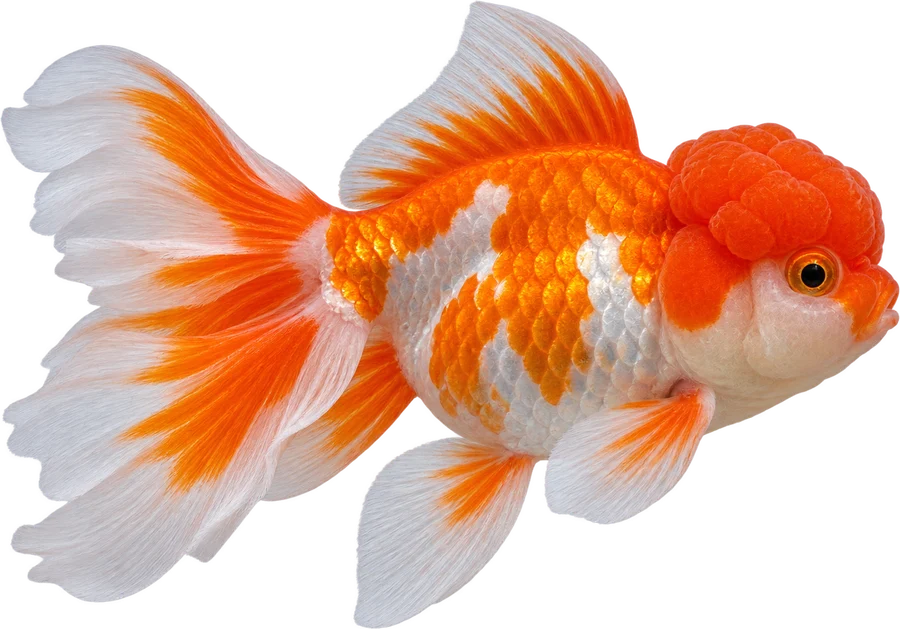
Fancy goldfish are the round-bodied, double-tailed goldfish varieties such as the oranda, with its raspberry-like head growth, and the high-backed ryukin. They were developed over centuries in China and Japan and are loved for their slow, wobbling swimming style and bold personalities. They stay shorter than pond goldfish but become heavy, messy fish that need far more room than a bowl.
- Grows to
- 8 in
- Smallest tank
- 29 gallons
- Temperature
- 65 to 75°F
- Water
- Fresh water
- Swims
- The middle of the tank
- Buy together
- One is fine
- Lives
- 10 to 20 years
- With tank mates
- Eats small fish
Is it right for you?
Better with some experience. The rounded body makes it prone to floating and sinking problems, and its heavy waste demands a large tank, strong filtration and regular big water changes.
It is peaceful and slow moving, and it is clumsy compared with slim goldfish. It can be pushed aside at feeding time by faster fish.
What keepers say
Keepers find fancy goldfish full of character but more delicate than their tough reputation suggests. The topic that comes up most is fish that float, sink or tip over, which keepers link to the squashed body shape, overfeeding and water quality. Keepers also tend to recommend more space than the usual printed minimums.
What keepers like
- Keepers like the size and presence a grown fancy goldfish has, with some reaching the size of a softball.
- Keepers report that some fish with floating or tilting trouble recover after large water changes, lighter feeding or treatment.
- A 75 gallon tank is seen as a practical size that gives a pair of goldfish room to grow.
Good to know first
- A common complaint is floating, sinking or tilting, which keepers say round-bodied varieties are prone to because their organs are crowded.
- Keepers report that it is hard to pin down the cause when a fish becomes swollen or sluggish, and that home treatments often bring little change.
- Keepers say a fancy goldfish can outgrow a 40 gallon tank and look cramped in it.
Tips keepers repeat
- Keepers suggest planning on roughly 30 to 40 gallons per fancy goldfish, not the bare minimum.
- Weekly water changes of 25 to 50 percent are widely repeated, because infrequent changes let nitrate build up.
- Keepers advise feeding less when a fish starts to float, and many offer shelled, cooked peas after a short fast.
- Oversized filtration is recommended, because the stated rating on a filter is often too optimistic for goldfish.
Summarised from keeper discussion on monsterfishkeepers.com. Links are at the foot of the page.
What it needs
| Tank | 29 gallons or more. Best with other fancy goldfish; allow at least 10 more gallons for each extra fish. |
|---|---|
| Water | 65 to 75°F, pH 6.5 to 7.5. Fresh water. |
| Food | It is an omnivore that eats quality goldfish pellets, frozen foods such as brine shrimp, and vegetables. Two small meals a day are better than one large one. |
| Lifespan | 10 to 20 years with good care, so it is a long commitment. |
| Comes from | It does not live in the wild; fancy varieties were bred from domestic goldfish in Asia, mainly China and Japan. |
One fancy goldfish is fine on its own. Of the standard tank sizes, the 29, 40, 55, 75 and larger gallon tanks are big enough. Fish are counted at the size they grow to: a 8 inch adult takes far more room than the young fish in the store.
Who it can live with
Often kept with
- Orandas
- Ryukins
- Fantails and other round-bodied fancy goldfish of a similar size
Best kept apart from
- Comet and common goldfish, because fast single-tailed goldfish take most of the food
- Tropical fish that need warm water, because goldfish prefer cooler tanks
- Small fish that fit in its mouth, because goldfish may swallow them
Against the other fish on this site
- Will eat: white cloud minnow, neon tetra, zebra danio, guppy, cherry barb, harlequin rasbora, otocinclus catfish, cardinal tetra, ember tetra, galaxy rasbora, endler livebearer, pygmy cory catfish, bumblebee goby, glowlight tetra, rummy nose tetra, serpae tetra, black neon tetra, honey gourami, german blue ram, panda cory catfish, cherry shrimp. Anything that fits in its mouth is food.
- Gets nipped by: tiger barb, yellow lab cichlid.
- Wants different water temperature: betta (male), angelfish, pearl gourami, discus, boeseman's rainbowfish.
- No clash on size or temperature: comet goldfish, rosy red minnow, bronze cory catfish, sunburst platy, red swordtail, black skirt tetra, dwarf gourami, rainbow shark, bala shark, hillstream loach, congo tetra, jack dempsey, common pleco, pictus catfish, dalmatian molly, mystery snail.
That list is worked out from adult size and temperature alone. Individual fish vary, and a tank that is too small makes peaceful fish fight.
Where new owners go wrong
- Keeping one in a bowl or small tank, which stunts the fish and shortens its life.
- Overfeeding, which leads to bloating and buoyancy problems.
- Mixing fancy goldfish with fast single-tailed goldfish that beat them to the food.
- Letting nitrate climb between water changes, which is linked to floating and tilting.
At the store
What to look for, and ask, before one goes in the bag.
- Watch the fish swim and pass on any that float at the top, sit on the bottom, tilt or swim head-down.
- Avoid fish with clamped fins, white spots, red or patchy skin or a swollen belly.
- On orandas, check that the head growth is not covering the eyes.
- Ask what the fish is being fed and plan to keep a new fish apart from existing ones for about 30 days.
What to buy for it
The smallest standard tank that suits it is the 29 gallon (30 x 12 x 18 inches), which weighs about 314 lb when full. It does not need a heater in a normally warm room. A real tank that is big enough: Aqueon 29 Gallon, 29 gallons, $129.99 on Amazon on 22 Nov 2026 (paid link). Heaters and filters are not linked to products yet.
Paid links: the stand names below link to Amazon and earn the site a commission.
| Stand that fits a 29 gallon | Top | Rated load | Price, 23 Nov 2026 |
|---|---|---|---|
| Bestier 20 to 37 gallon stand | 30.7 x 13.8 in | 400 lb | $71.39 |
| POKIPO 20 to 29 gallon stand, slide-out shelf | 31.5 x 15.8 in | 770 lb | $93.49 |
| TOCRETOARE 40 gallon metal stand | 36.5 x 18.5 in | 660 lb | $69.99 |
For the floor of the tank, sand and gravel shows how many pounds a 29 gallon takes. Stands compares every stand.
See it before you buy it
Put one fancy goldfish in a tank that is big enough, add the fish you were thinking of keeping with it, and watch what the tank says about stocking, temperature and who gets along.
Sources
Checked on 23 November 2026. Tank size advice ranges from 20 gallons for the first fish plus 10 for each extra to a 29 gallon minimum, and keepers often suggest 30 to 40 gallons per fish; the figure here takes the larger reference minimum. Adult size is given as 6 inches or more by one reference and up to 10 inches by another, so 8 inches is used as a middle figure, and one guide puts the temperature range lower at 50 to 70 degrees Fahrenheit.
- Aquarium Co-Op: Care guide for fancy goldfish care reference
- LiveAquaria: Fancy goldfish (oranda, black moor, ryukin, pearlscale) care reference
- PetSmart: Goldfish and koi care guide care reference
- INJAF: Fancy goldfish and swimbladder or buoyancy problems care reference
- Monster Fish Keepers forum thread on oranda goldfish problems keeper discussion
- Monster Fish Keepers forum thread on floating and sinking fish keeper discussion
- Monster Fish Keepers forum thread on goldfish space requirements keeper discussion
Care figures here come from the references listed and can still be wrong or out of date. Individual fish and tanks vary. Check with the store and a second care reference before you buy. Terms.