 Aquarium Fish Guide
Build a tank / Fish / Tiger barb
Tiger barb
Puntigrus tetrazona
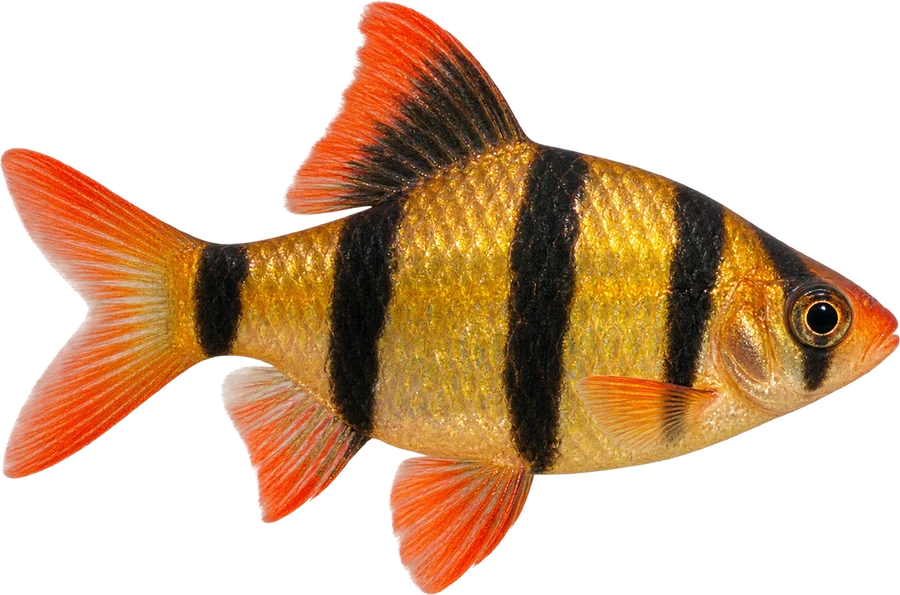
The tiger barb is a small, deep-bodied schooling fish with bold dark stripes, also sold in green, albino and long-finned forms. People buy it because a group is always moving, chasing and sparring. That same energy makes it a well-known fin nipper, so it has to be housed with care.
- Grows to
- 3 in
- Smallest tank
- 29 gallons
- Temperature
- 72 to 79°F
- Water
- Fresh water
- Swims
- The middle of the tank
- Buy together
- 6 or more
- Lives
- 5 to 7 years
- With tank mates
- Chases and nips
Is it right for you?
Good for a first tank. It is hardy and easy to feed, but it only behaves in a big group with carefully chosen tank mates.
It is boisterous and semi-aggressive, with a habit of nipping fins. A large school keeps most of the squabbling inside the group.
What keepers say
Keepers agree that tiger barbs are entertaining and tough, and that they nip. The common view is that a small group is the worst case and a big school is much better, although several keepers say even ten or more will still go after tempting fins now and then.
What keepers like
- Keepers enjoy the constant activity and the sparring displays inside the school.
- Keepers find them hardy and quick to settle in.
- Keepers with larger schools and more females than males report little trouble for other fish.
Good to know first
- A common complaint is persistent tail nipping of long-finned tank mates such as angelfish.
- Keepers report weaker or smaller barbs being battered, and sometimes killed, by their own group.
- Some keepers find that a school of ten still nips, so a large group is no guarantee.
- Keepers describe the behavior as hit and miss, which makes it hard to plan around.
Tips keepers repeat
- Keepers say to keep as many as the tank can safely hold so aggression is spread out.
- Keepers suggest more females than males, since groups heavy on males fight the most.
- Keepers advise skipping long-finned or slow tank mates completely instead of hoping the barbs behave.
- Keepers often point people toward cherry barbs when they want a calmer barb.
Summarised from keeper discussion on monsterfishkeepers.com, fishprofiles.com. Links are at the foot of the page.
What it needs
| Tank | 29 gallons or more. A school of 8 or more, and 12 is better. |
|---|---|
| Water | 72 to 79°F, pH 6 to 8. Fresh water. Needs a heater in most homes. |
| Food | It is an omnivore that eats flakes, small pellets and frozen or live foods very quickly. Some vegetable matter or roughage such as daphnia should be part of the mix. |
| Lifespan | 5 to 7 years with good care, so it is a long commitment. |
| Comes from | It comes from rivers in central and southern Sumatra in Indonesia, and almost all fish for sale are farm bred. |
Tiger barbs school. In ones and twos they hide and stress, so plan for six or more. Of the standard tank sizes, the 29, 40, 55, 75 and larger gallon tanks are big enough. Fish are counted at the size they grow to: a 3 inch adult takes far more room than the young fish in the store.
Who it can live with
Often kept with
- Zebra danios
- Clown loaches, in a large tank
- Other active barbs of similar size
- Corydoras and most other catfish
- Platies
Best kept apart from
- Bettas, because their long fins get shredded
- Angelfish, for the same reason
- Gouramis, which are slow and have trailing feelers
- Guppies and other long-finned livebearers
- Shy, slow feeders, which get outcompeted at mealtimes
Against the other fish on this site
- Gets eaten by: comet goldfish, oscar, bala shark, jack dempsey.
- Chases and nips: fancy goldfish, guppy, betta (male), angelfish, dwarf gourami.
- Wants different water temperature: german blue ram, boeseman's rainbowfish.
- No clash on size or temperature: rosy red minnow, neon tetra, zebra danio, bronze cory catfish, bristlenose pleco, black molly, sunburst platy, red swordtail, cherry barb, black skirt tetra, harlequin rasbora, kuhli loach, yellow lab cichlid, rainbow shark, otocinclus catfish, clown loach, cardinal tetra, ember tetra, galaxy rasbora, endler livebearer, pygmy cory catfish, bumblebee goby, hillstream loach, glowlight tetra, rummy nose tetra, serpae tetra, black neon tetra, congo tetra, pearl gourami, honey gourami, blue gourami, kribensis, convict cichlid, firemouth cichlid, panda cory catfish, common pleco, siamese algae eater, pictus catfish, dalmatian molly, cherry shrimp, mystery snail.
That list is worked out from adult size and temperature alone. Individual fish vary, and a tank that is too small makes peaceful fish fight.
Where new owners go wrong
- New owners buy three to five tiger barbs, which is the group size most likely to cause nipping and bullying.
- New owners add them to a tank with a betta, angelfish or guppies.
- New owners squeeze a school into a 10 or 20 gallon tank, where cramped space makes the aggression worse.
- New owners overdo rich foods such as bloodworms and skip plant matter.
At the store
What to look for, and ask, before one goes in the bag.
- Plan to buy the whole school at once, and check that the store has enough healthy fish.
- Avoid tanks with thin, bent or misshapen fish, since farmed stock can be weak or deformed.
- Look for strong color and upright fins, and skip fish hanging head down or off in a corner.
- Ask what the barbs are being kept with at the store, and do not accept a claim that a few will be fine with long-finned fish.
What to buy for it
The smallest standard tank that suits it is the 29 gallon (30 x 12 x 18 inches), which weighs about 314 lb when full. It needs a heater in most homes. A real tank that is big enough: Aqueon 29 Gallon, 29 gallons, $129.99 on Amazon on 22 Nov 2026 (paid link). Heaters and filters are not linked to products yet.
Paid links: the stand names below link to Amazon and earn the site a commission.
| Stand that fits a 29 gallon | Top | Rated load | Price, 23 Nov 2026 |
|---|---|---|---|
| Bestier 20 to 37 gallon stand | 30.7 x 13.8 in | 400 lb | $71.39 |
| POKIPO 20 to 29 gallon stand, slide-out shelf | 31.5 x 15.8 in | 770 lb | $93.49 |
| TOCRETOARE 40 gallon metal stand | 36.5 x 18.5 in | 660 lb | $69.99 |
For the floor of the tank, sand and gravel shows how many pounds a 29 gallon takes. Stands compares every stand.
See it before you buy it
Put 6 tiger barbs in a tank that is big enough, add the fish you were thinking of keeping with them, and watch what the tank says about stocking, temperature and who gets along.
Sources
Checked on 23 November 2026. References differ on the smallest tank, from about 19 gallons to 29 gallons, and on the smallest group, from 6 to 8 or 10, so the more cautious numbers are used here. Lifespan figures also vary, with most falling between 5 and 7 years.
- Seriously Fish: Puntigrus tetrazona care reference
- Aquarium Co-Op: Care Guide for Tiger Barbs care reference
- Wikipedia: Tiger barb care reference
- Monster Fish Keepers forum thread on tiger barb aggression keeper discussion
- FishProfiles forum thread on tiger barb group behavior keeper discussion
Care figures here come from the references listed and can still be wrong or out of date. Individual fish and tanks vary. Check with the store and a second care reference before you buy. Terms.