 Aquarium Fish Guide
Build a tank / Fish / Pygmy cory catfish
Pygmy cory catfish
Corydoras pygmaeus
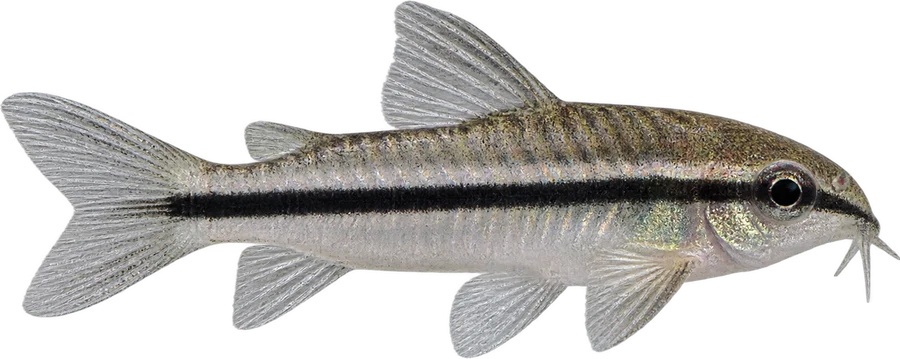
The pygmy corydoras is a miniature catfish from Brazil that grows to about an inch. It is silver with a thin black stripe from nose to tail, and unlike other corydoras it often hovers in the middle of the tank and perches on leaves instead of staying on the bottom. People keep it as a peaceful, busy little group for small planted tanks.
- Grows to
- 1.2 in
- Smallest tank
- 10 gallons
- Temperature
- 72 to 78°F
- Water
- Fresh water
- Swims
- Low in the tank
- Buy together
- 6 or more
- Lives
- 3 to 5 years
- With tank mates
- Peaceful
Is it right for you?
Better with some experience. It is easy to underfeed in a community tank and tends to do poorly in new tanks or small groups.
It is very peaceful and timid, and it is easily scared off its food by bigger or faster fish.
What keepers say
Keepers find pygmy corydoras charming in a big group and frustrating in a small one. The common themes are shyness, the need for numbers, and the work of getting enough food to them before faster fish take it.
What keepers like
- Keepers like that they are tiny and completely peaceful.
- Keepers enjoy watching a group school in the middle of the tank, sometimes alongside small tetras.
- Keepers like that they graze over plant leaves and rest on them.
- Keepers report that large groups are much bolder and more active.
Good to know first
- A common complaint is that they are shy and hard to spot, especially in small numbers.
- Keepers say faster tank mates eat sinking tablets and pellets before the pygmies reach them.
- Keepers report that underfed fish can waste away without it being obvious.
- Some keepers find them duller to watch than other dwarf corydoras.
Tips keepers repeat
- Keepers recommend a group of at least 8, and many say 20 or more makes the biggest difference.
- Keepers suggest grinding flakes very fine and placing food on leaves or in a small dish where the group can find it.
- Keepers say a few weeks of live or frozen worms can get reluctant fish eating.
- Keepers advise heavy planting and cover so the fish feel safe.
Summarised from keeper discussion on aquariacentral.com. Links are at the foot of the page.
What it needs
| Tank | 10 gallons or more. At least 6, and 8 to 12 or more is better. |
|---|---|
| Water | 72 to 78°F, pH 6.4 to 7.4. Fresh water. Needs a heater in most homes. |
| Food | It needs tiny sinking foods such as small pellets, crushed flakes and broken wafers. Small frozen or live foods like daphnia, cyclops and baby brine shrimp should be a regular part of its diet. |
| Lifespan | 3 to 5 years with good care, so it is a long commitment. |
| Comes from | It comes from the Madeira River basin in Brazil. |
Pygmy corys school. In ones and twos they hide and stress, so plan for six or more. Of the standard tank sizes, the 10, 15, 20, 29 and larger gallon tanks are big enough. Fish are counted at the size they grow to: a 1.2 inch adult takes far more room than the young fish in the store.
Who it can live with
Often kept with
- Ember tetras
- Chili rasboras
- Celestial pearl danios
- Neon tetras
- Otocinclus catfish
- Snails and adult dwarf shrimp
Best kept apart from
- Any fish large enough to eat them
- Fast, greedy feeders such as bigger tetras and livebearers, which take the food first
- Aggressive or territorial fish, which keep them hiding
- Baby shrimp, which they may eat
Against the other fish on this site
- Gets eaten by: comet goldfish, fancy goldfish, angelfish, oscar, yellow lab cichlid, bala shark, blue gourami, convict cichlid, jack dempsey, firemouth cichlid, discus, pictus catfish.
- Wants different water temperature: german blue ram, boeseman's rainbowfish.
- No clash on size or temperature: rosy red minnow, neon tetra, zebra danio, guppy, betta (male), bronze cory catfish, bristlenose pleco, black molly, sunburst platy, red swordtail, tiger barb, cherry barb, black skirt tetra, harlequin rasbora, dwarf gourami, kuhli loach, rainbow shark, otocinclus catfish, clown loach, cardinal tetra, ember tetra, galaxy rasbora, endler livebearer, bumblebee goby, hillstream loach, glowlight tetra, rummy nose tetra, serpae tetra, black neon tetra, congo tetra, honey gourami, kribensis, panda cory catfish, common pleco, siamese algae eater, dalmatian molly, cherry shrimp, mystery snail.
That list is worked out from adult size and temperature alone. Individual fish vary, and a tank that is too small makes peaceful fish fight.
Where new owners go wrong
- New owners often buy two or three as a cleanup crew, when they need a real group and their own food.
- New owners often assume they will live on leftovers and end up with thin fish.
- New owners often feed foods that are too large for their small mouths.
- New owners often keep them on sharp, coarse gravel, when fine sand is kinder to their barbels.
At the store
What to look for, and ask, before one goes in the bag.
- Check for a thin black stripe along the body and no large tail spot, since other dwarf corydoras are sold under the same name.
- Look for rounded bellies and whiskers that are intact and not worn down.
- Choose from a group that is active and moving together, not sitting still.
- Buy the whole group at once and ask what they are eating in the store.
What to buy for it
The smallest standard tank that suits it is the 10 gallon (20 x 10 x 12 inches), which weighs about 109 lb when full. It needs a heater in most homes. A real tank that is big enough: Aqueon 20 Gallon Long, 20 gallons, $99.99 on Amazon on 22 Nov 2026 (paid link). Heaters and filters are not linked to products yet.
Paid links: the stand names below link to Amazon and earn the site a commission.
| Stand that fits a 10 gallon | Top | Rated load | Price, 23 Nov 2026 |
|---|---|---|---|
| Snughome 10 to 20 gallon stand, two shelves | 24 x 11.8 in | 350 lb | $33.24 |
| MAHANCRIS 10 gallon stand with cabinet | 23.6 x 11.8 in | 450 lb | $53.99 |
| Bestier 20 to 37 gallon stand | 30.7 x 13.8 in | 400 lb | $71.39 |
For the floor of the tank, sand and gravel shows how many pounds a 10 gallon takes. Stands compares every stand.
See it before you buy it
Put 6 pygmy corys in a tank that is big enough, add the fish you were thinking of keeping with them, and watch what the tank says about stocking, temperature and who gets along.
Sources
Checked on 23 November 2026. References give a minimum group of 6 to 12, while experienced keepers often suggest 20 or more for confident behavior. Tank size is given as 5 to about 11 gallons, and the larger figure is used here. Lifespan figures range from about 3 to 5 years.
- Seriously Fish: pygmy cory care reference
- Aquarium Co-Op: pygmy corydoras care guide care reference
- Aquarium Source: pygmy cory care care reference
- Aquaria Central thread on pygmy corydoras and otocinclus keeper discussion
- Aquaria Central thread comparing the three dwarf corydoras keeper discussion
Care figures here come from the references listed and can still be wrong or out of date. Individual fish and tanks vary. Check with the store and a second care reference before you buy. Terms.