 Aquarium Fish Guide
Build a tank / Fish / Siamese algae eater
Siamese algae eater
Crossocheilus langei (often sold as Crossocheilus siamensis or Crossocheilus oblongus)
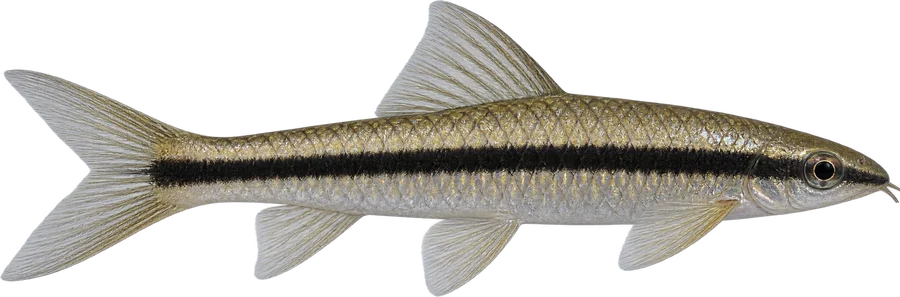
The Siamese algae eater is a slim, silvery-brown fish from Southeast Asia with a bold black stripe that runs from the nose right through to the end of the tail. It is one of the few fish that eats black brush algae, also called black beard algae, which is why planted tank owners look for it. It grows to about 6 inches, so it is a bigger and more active fish than the small ones in the store tank suggest.
- Grows to
- 6 in
- Smallest tank
- 75 gallons
- Temperature
- 75 to 79°F
- Water
- Fresh water
- Swims
- Low in the tank
- Buy together
- One is fine
- Lives
- 8 to 10 years
- With tank mates
- Peaceful
Is it right for you?
Good for a first tank. It is hardy and easy to feed, and the main challenges are giving a group enough room and making sure the fish sold is the real species.
It is generally peaceful and suits most community tanks, though it is fast and busy. Members of a group sort out a pecking order, and a pair kept together may each claim a territory as they mature.
What keepers say
Keepers value young Siamese algae eaters as hard workers and are less impressed with adults. The two themes that come up again and again are that grown fish lose interest in algae once they learn about fish food, and that many fish sold under this name are really a different species.
What keepers like
- Keepers report that young fish clear the algae from a well-established tank within a few weeks.
- The fish are described as healthy, plump and easy to keep.
- Keepers like the look of the true species, with its clean black stripe running through the tail.
- They are seen as a useful worker for planted tanks, where few other fish touch brush algae.
Good to know first
- A common complaint is that older fish stop cleaning plants and wait for pellets instead.
- Keepers report buying fish labeled as Siamese algae eaters that turned out to be Chinese algae eaters or flying foxes.
- Two adults kept together are reported to square off and wrestle, especially at feeding time.
- Keepers note that mature fish may eat the fry of other fish.
Tips keepers repeat
- Keepers suggest feeding lightly, or skipping food for a few days, to push the fish back toward grazing.
- Checking that the black stripe runs all the way through the tail is the usual quick test for the real fish.
- Keepers advise against treating the fish as the fix for an algae problem, because the cause of the algae still has to be dealt with.
Summarised from keeper discussion on monsterfishkeepers.com. Links are at the foot of the page.
What it needs
| Tank | 75 gallons or more. A group of 6 or more is best; a single fish also works, but two or three tend to squabble. |
|---|---|
| Water | 75 to 79°F, pH 6.5 to 7.5. Fresh water. Needs a heater in most homes. |
| Food | It grazes on algae and the film that grows on surfaces, and it also takes most prepared foods. Sinking foods with spirulina and fresh vegetables such as zucchini, peas and spinach suit it better than rich, high-protein food. |
| Lifespan | 8 to 10 years with good care, so it is a long commitment. |
| Comes from | It comes from streams and rivers in Southeast Asia, including the Malay Peninsula, Sumatra and Borneo. |
One siamese algae eater is fine on its own. Of the standard tank sizes, the 75, 125, 180, 240 gallon tanks are big enough. Fish are counted at the size they grow to: a 6 inch adult takes far more room than the young fish in the store.
Who it can live with
Often kept with
- Barbs
- Danios
- Rasboras
- Tetras
- Gouramis
- Corys and other peaceful bottom fish
Best kept apart from
- Red-tailed sharks and rainbow sharks, because these related fish fight with it over territory
- Flying foxes and Chinese algae eaters, because they look similar and are more aggressive
- Very slow or long-finned fish, because its constant activity bothers them
- Tiny fry and baby fish, because adults will eat them
Against the other fish on this site
- Wants different water temperature: white cloud minnow, german blue ram, boeseman's rainbowfish.
- No clash on size or temperature: neon tetra, guppy, betta (male), oscar, bronze cory catfish, bristlenose pleco, black molly, sunburst platy, red swordtail, tiger barb, cherry barb, black skirt tetra, harlequin rasbora, dwarf gourami, kuhli loach, yellow lab cichlid, rainbow shark, bala shark, otocinclus catfish, clown loach, cardinal tetra, ember tetra, galaxy rasbora, endler livebearer, pygmy cory catfish, bumblebee goby, glowlight tetra, rummy nose tetra, serpae tetra, black neon tetra, congo tetra, pearl gourami, honey gourami, blue gourami, kribensis, convict cichlid, jack dempsey, firemouth cichlid, panda cory catfish, common pleco, pictus catfish, dalmatian molly, cherry shrimp, mystery snail.
That list is worked out from adult size and temperature alone. Individual fish vary, and a tank that is too small makes peaceful fish fight.
Where new owners go wrong
- Buying a look-alike, such as a Chinese algae eater or a flying fox, which grows more aggressive and eats less algae.
- Putting a 6 inch, active schooling fish in a small tank because it was sold at 1.5 inches.
- Overfeeding, which teaches the fish to ignore algae.
- Leaving gaps in the lid, because this fish is known to jump.
At the store
What to look for, and ask, before one goes in the bag.
- Look for a black stripe with slightly ragged edges that continues to the very end of the tail, and for clear fins with no yellow, red or black bands.
- Be wary of a fish with a sucker-like mouth that sticks to the glass, because that is likely a Chinese algae eater.
- Ask the store which species it is, and expect that several close relatives are sold under the same name.
- Pick active fish with rounded bellies, and plan the tank for their 6 inch adult size.
What to buy for it
The smallest standard tank that suits it is the 75 gallon (48 x 18 x 21 inches), which weighs about 827 lb when full. It needs a heater in most homes. No real tank this large is listed here yet. Heaters and filters are not linked to products yet.
Paid links: the stand names below link to Amazon and earn the site a commission.
| Stand that fits a 75 gallon | Top | Rated load | Price, 23 Nov 2026 |
|---|---|---|---|
| GRLEAF 55 to 75 gallon stand | 49 x 19 in | 1000 lb | $118.99 |
| HOOBRO 75 gallon stand, two drawers | 52 x 19.7 in | 1146 lb | $103.99 |
| VOWNER 125 to 150 gallon stand with cabinet | 72.9 x 18.9 in | 2200 lb | $223.99 |
For the floor of the tank, sand and gravel shows how many pounds a 75 gallon takes. Stands compares every stand.
See it before you buy it
Put one siamese algae eater in a tank that is big enough, add the fish you were thinking of keeping with it, and watch what the tank says about stocking, temperature and who gets along.
Sources
Checked on 23 November 2026. References disagree on the scientific name, and the fish sold in stores may be one of several closely related species. One specialist reference asks for a group of six in a tank of about 80 gallons with a 60 inch base, and that cautious figure is used here, while another reference says the fish can also live alone, which many keepers do in smaller tanks. References also differ on how much brush algae it really eats, with some saying only young growth is eaten.
- Seriously Fish: Crossocheilus langei care reference
- Wikipedia: Siamese algae eater care reference
- Monster Fish Keepers forum thread on Siamese algae eaters that stopped cleaning keeper discussion
- Monster Fish Keepers forum thread on Siamese algae eaters fighting keeper discussion
- Monster Fish Keepers forum thread on identifying a true Siamese algae eater keeper discussion
Care figures here come from the references listed and can still be wrong or out of date. Individual fish and tanks vary. Check with the store and a second care reference before you buy. Terms.