 Aquarium Fish Guide
Build a tank / Fish / German blue ram
German blue ram
Mikrogeophagus ramirezi
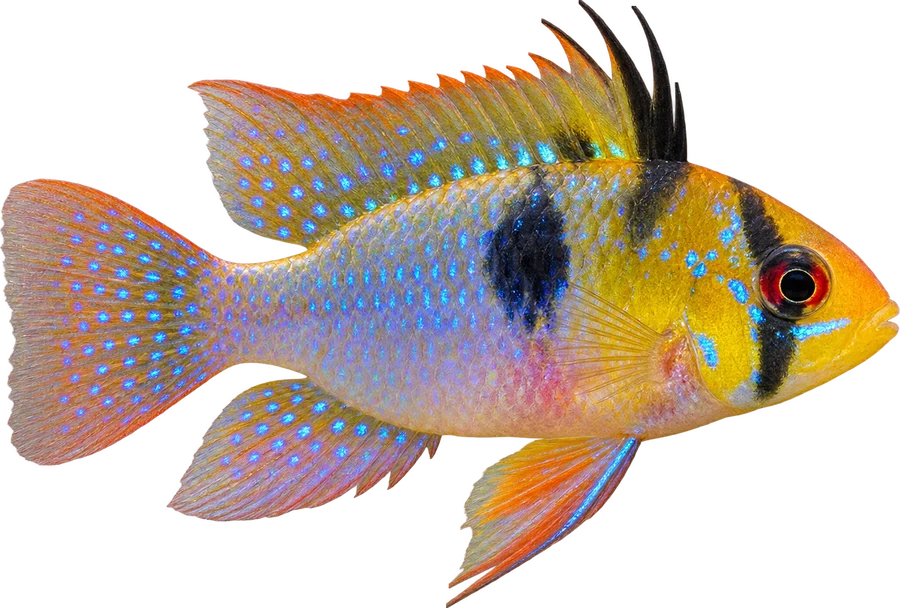
The German blue ram is a dwarf cichlid about 2 inches long with a yellow head, a body covered in electric blue spangles, a black bar through a red eye and a black spot on its side. Gold, electric blue, long-finned and balloon forms of the same species are also sold. People want it for its color and its pair-bonding, egg-guarding behavior, but it needs very warm, clean water and has a reputation for dying in ordinary community tanks.
- Grows to
- 2 in
- Smallest tank
- 20 gallons
- Temperature
- 82 to 86°F
- Water
- Fresh water
- Swims
- Low in the tank
- Buy together
- One is fine
- Lives
- 2 to 4 years
- With tank mates
- Peaceful
Is it right for you?
For experienced keepers. It needs steady water in the low to mid 80s, a mature tank and very clean water, and mass-produced fish are often weak to begin with.
It is peaceful for a cichlid and a poor competitor. A pair defends a patch of the bottom when it has eggs, and males do not tolerate other males in a small tank.
What keepers say
Keepers love the look and personality of German blue rams and widely describe them as sensitive fish that die without an obvious cause. Most blame cool water, immature or dirty tanks and weak mass-bred stock. Keepers who run warm, stable, established tanks report much better results.
What keepers like
- Keepers praise the color and the character of a bonded pair.
- Keepers find that established pairs spawn readily.
- Keepers report that rams rarely bother small tetras.
- Some keepers report rams adapting to harder, higher pH tap water when acclimated slowly.
Good to know first
- A common complaint is rams dying one by one with no visible injury or disease.
- Keepers say rams kept below about 80 F are prone to ich and tend to waste away slowly.
- Keepers report that commercially bred rams, and the long-finned, balloon and electric blue forms in particular, are less hardy than older strains.
- Keepers note that a pair is never guaranteed to get along, and a third ram kept with a pair often gets harassed.
Tips keepers repeat
- Keepers recommend a steady temperature in the low 80s, checked with a thermometer that is known to be accurate.
- Keepers advise adding rams only to an established tank and keeping up with regular water changes.
- Keepers say stable water matters more than chasing soft, acidic numbers.
- Keepers suggest acclimating new rams slowly over an hour or two and buying from a reliable source.
Summarised from keeper discussion on aquariacentral.com, monsterfishkeepers.com. Links are at the foot of the page.
What it needs
| Tank | 20 gallons or more. A single male and female pair, with two pairs only in 40 gallons or more. |
|---|---|
| Water | 82 to 86°F, pH 5 to 7. Fresh water. Needs a heater in most homes. |
| Food | It sifts the bottom for food and takes sinking pellets along with frozen foods such as bloodworms, brine shrimp and daphnia. It is a slow feeder that loses out to fast, greedy tank mates. |
| Lifespan | 2 to 4 years with good care, so it is a long commitment. |
| Comes from | It comes from warm, soft, acidic waters on the seasonally flooded plains of the Orinoco River basin in Venezuela and Colombia. |
One german blue ram is fine on its own. Of the standard tank sizes, the 20, 29, 40, 55 and larger gallon tanks are big enough. Fish are counted at the size they grow to: a 2 inch adult takes far more room than the young fish in the store.
Who it can live with
Often kept with
- Cardinal tetras
- Rummy nose tetras
- Sterbai corydoras
- Bristlenose plecos
- Discus
- Green neon tetras
Best kept apart from
- Fish that need cooler water, such as neon tetras, goldfish and paradise fish, because the ram's temperature is too hot for them
- Kribensis and most other cichlids, which bully it and contest its territory
- Oscars and other large fish, which eat or terrorize it
- Fast, greedy feeders such as tiger barbs, which take all the food
Against the other fish on this site
- Gets eaten by: comet goldfish, fancy goldfish, oscar, bala shark, convict cichlid, jack dempsey.
- Wants different water temperature: rosy red minnow, white cloud minnow, neon tetra, zebra danio, guppy, bronze cory catfish, bristlenose pleco, black molly, sunburst platy, tiger barb, cherry barb, black skirt tetra, harlequin rasbora, dwarf gourami, kuhli loach, yellow lab cichlid, rainbow shark, otocinclus catfish, galaxy rasbora, pygmy cory catfish, hillstream loach, rummy nose tetra, serpae tetra, honey gourami, kribensis, panda cory catfish, siamese algae eater, pictus catfish, cherry shrimp, mystery snail.
- No clash on size or temperature: angelfish, clown loach, cardinal tetra, endler livebearer, firemouth cichlid, discus, common pleco, boeseman's rainbowfish.
That list is worked out from adult size and temperature alone. Individual fish vary, and a tank that is too small makes peaceful fish fight.
Where new owners go wrong
- New owners keep them at ordinary community temperatures in the mid 70s, where they slowly decline.
- New owners add them to a new tank that has not finished cycling.
- New owners pick tank mates that cannot handle water in the mid 80s.
- New owners buy a skinny or pale fish hoping it will recover, when sick rams rarely do.
At the store
What to look for, and ask, before one goes in the bag.
- Choose a sturdy, active fish that eats in front of you, and skip any with a thin body or hollow belly.
- Ask where the fish were bred, since locally bred rams are usually the hardiest.
- Ask what temperature and pH the store keeps them in.
- To pick a pair, look for the pink belly and the blue sparkles inside the black side spot that mark a female.
What to buy for it
The smallest standard tank that suits it is the 20 gallon (24 x 12 x 16 inches), which weighs about 211 lb when full. It needs a heater in most homes. A real tank that is big enough: Aqueon 20 Gallon Long, 20 gallons, $99.99 on Amazon on 22 Nov 2026 (paid link). Heaters and filters are not linked to products yet.
Paid links: the stand names below link to Amazon and earn the site a commission.
| Stand that fits a 20 gallon | Top | Rated load | Price, 23 Nov 2026 |
|---|---|---|---|
| Bestier 20 to 37 gallon stand | 30.7 x 13.8 in | 400 lb | $71.39 |
| POKIPO 20 to 29 gallon stand, slide-out shelf | 31.5 x 15.8 in | 770 lb | $93.49 |
| TOCRETOARE 40 gallon metal stand | 36.5 x 18.5 in | 660 lb | $69.99 |
For the floor of the tank, sand and gravel shows how many pounds a 20 gallon takes. Stands compares every stand.
See it before you buy it
Put one german blue ram in a tank that is big enough, add the fish you were thinking of keeping with it, and watch what the tank says about stocking, temperature and who gets along.
Sources
Checked on 23 November 2026. References disagree on temperature: one puts the natural range at about 78 to 85 F, while two care references ask for 81 to 86 F or 84 to 86 F, and keepers themselves argue between about 80 F and the mid 80s. A range of 82 to 86 F is given here. References also disagree on adult size, from 1.6 inches to 2.5 inches, and one advises against keeping it in a general community tank at all.
- Seriously Fish: Mikrogeophagus ramirezi care reference
- Aquarium Co-Op: ram cichlid care guide care reference
- Wikipedia: Ram cichlid care reference
- Aquaria Central forum thread: German Blue Rams dying, no clue why keeper discussion
- Aquaria Central forum thread: German Blue Ram (Microgeophagus ramirezi) keeper discussion
- Aquaria Central forum thread: I Need German Blue Ram Help keeper discussion
- Monster Fish Keepers forum thread: Bolivian and Blue Rams and tankmates keeper discussion
Care figures here come from the references listed and can still be wrong or out of date. Individual fish and tanks vary. Check with the store and a second care reference before you buy. Terms.