 Aquarium Fish Guide
Build a tank / Fish / Black skirt tetra
Black skirt tetra
Gymnocorymbus ternetzi
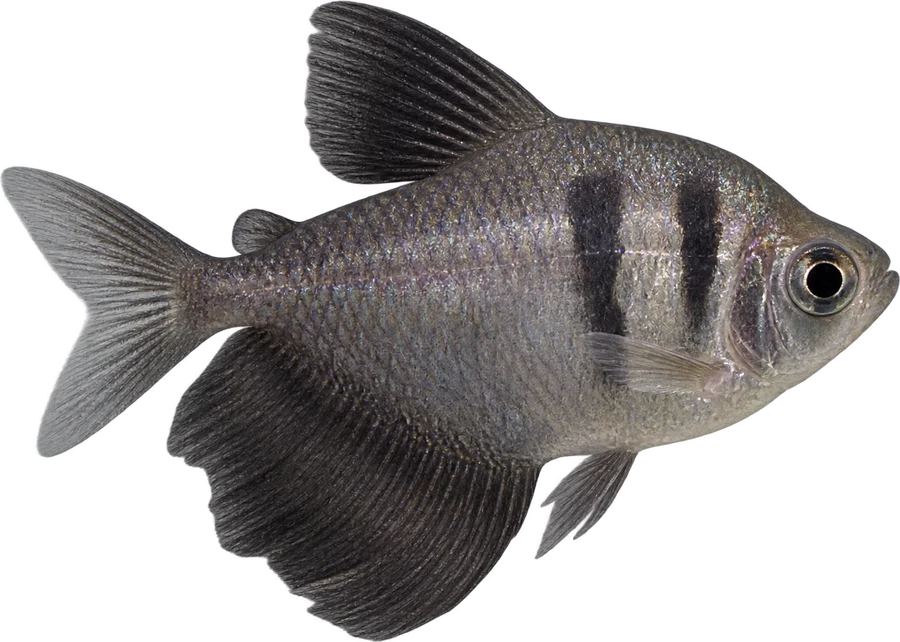
The black skirt tetra, also called the black widow tetra, is a deep-bodied gray tetra that darkens toward the tail, giving the look of a dark skirt. It is cheap, tough and widely sold, including long-finned, white and fluorescent forms. It is lively in a school, with a reputation for nipping fins when kept in small numbers.
- Grows to
- 3 in
- Smallest tank
- 20 gallons
- Temperature
- 68 to 79°F
- Water
- Fresh water
- Swims
- The middle of the tank
- Buy together
- 6 or more
- Lives
- 3 to 5 years
- With tank mates
- Chases and nips
Is it right for you?
Good for a first tank. It is hardy and eats anything, and the fin nipping is manageable with a big enough school.
It is lively and generally peaceful in a proper school. In small groups it can turn nippy toward tank mates and toward its own kind.
What keepers say
Keepers are divided on black skirt tetras. Some run them for years in community tanks with no damage, while others call them relentless nippers and end up moving them out. Most agree that group size and tank room decide which of the two a tank gets.
What keepers like
- Keepers like how tough and undemanding they are.
- Keepers with a full school in a roomy tank report an active group that keeps to itself.
- Keepers note that nipped fins usually grow back once the cause is fixed.
Good to know first
- A common complaint is persistent fin nipping that only stops when the tetras are moved to another tank.
- Keepers report the group singling out its weakest member, which ends up hiding with torn fins.
- Some keepers find that adding more fish does not help when the tank is too small to begin with.
Tips keepers repeat
- Keepers recommend six or more of the same kind so the nipping is shared out.
- Keepers suggest more plants and decorations to break lines of sight.
- Keepers advise a larger tank before adding more fish to an already crowded one.
- Keepers say to remove a single persistent bully if the rest of the group is calm.
Summarised from keeper discussion on aquariacentral.com. Links are at the foot of the page.
What it needs
| Tank | 20 gallons or more. A school of 6 at the very least, and closer to 12 to curb fin nipping. |
|---|---|
| Water | 68 to 79°F, pH 6 to 7. Fresh water. |
| Food | It is an unfussy omnivore that eats flakes and granules. Regular live or frozen foods such as daphnia and bloodworms keep it in good shape. |
| Lifespan | 3 to 5 years with good care, so it is a long commitment. |
| Comes from | It comes from the Paraguay River basin in Brazil, Paraguay, Bolivia and Argentina. |
Black skirt tetras school. In ones and twos they hide and stress, so plan for six or more. Of the standard tank sizes, the 20, 29, 40, 55 and larger gallon tanks are big enough. Fish are counted at the size they grow to: a 3 inch adult takes far more room than the young fish in the store.
Who it can live with
Often kept with
- Danios
- Rasboras
- Other robust tetras
- Corydoras catfish
- Small plecos
- Platies and other livebearers
Best kept apart from
- Bettas, because long fins invite nipping
- Guppies with long tails, for the same reason
- Adult angelfish, which get nipped when young and can eat tetras when large
- Very slow or timid fish, which get harassed
Against the other fish on this site
- Gets eaten by: comet goldfish, oscar, bala shark, jack dempsey.
- Chases and nips: guppy, betta (male), angelfish.
- Wants different water temperature: german blue ram, boeseman's rainbowfish.
- No clash on size or temperature: fancy goldfish, rosy red minnow, white cloud minnow, neon tetra, zebra danio, bronze cory catfish, bristlenose pleco, black molly, sunburst platy, red swordtail, tiger barb, cherry barb, harlequin rasbora, dwarf gourami, kuhli loach, yellow lab cichlid, rainbow shark, otocinclus catfish, clown loach, cardinal tetra, ember tetra, galaxy rasbora, endler livebearer, pygmy cory catfish, bumblebee goby, hillstream loach, glowlight tetra, rummy nose tetra, serpae tetra, black neon tetra, congo tetra, pearl gourami, honey gourami, blue gourami, kribensis, convict cichlid, firemouth cichlid, panda cory catfish, common pleco, siamese algae eater, pictus catfish, dalmatian molly, cherry shrimp, mystery snail.
That list is worked out from adult size and temperature alone. Individual fish vary, and a tank that is too small makes peaceful fish fight.
Where new owners go wrong
- New owners buy two or three, which is when the nipping is at its worst.
- New owners house them with a betta, guppies or other long-finned fish.
- New owners buy artificially dyed fish, a stressful process that often shortens the fish's life.
- New owners let a school shrink through losses without topping it up, and the survivors turn on tank mates.
At the store
What to look for, and ask, before one goes in the bag.
- Buy the whole school in one visit so the fish settle in together.
- Ask whether brightly colored fish are dyed, and avoid any that are.
- Check the fins of every fish in the tank, since torn fins point to nipping already under way.
- Decide between long-finned and standard fish, because long-finned ones are more likely to be nipped themselves.
What to buy for it
The smallest standard tank that suits it is the 20 gallon (24 x 12 x 16 inches), which weighs about 211 lb when full. It does not need a heater in a normally warm room. A real tank that is big enough: Aqueon 20 Gallon Long, 20 gallons, $99.99 on Amazon on 22 Nov 2026 (paid link). Heaters and filters are not linked to products yet.
Paid links: the stand names below link to Amazon and earn the site a commission.
| Stand that fits a 20 gallon | Top | Rated load | Price, 23 Nov 2026 |
|---|---|---|---|
| Bestier 20 to 37 gallon stand | 30.7 x 13.8 in | 400 lb | $71.39 |
| POKIPO 20 to 29 gallon stand, slide-out shelf | 31.5 x 15.8 in | 770 lb | $93.49 |
| TOCRETOARE 40 gallon metal stand | 36.5 x 18.5 in | 660 lb | $69.99 |
For the floor of the tank, sand and gravel shows how many pounds a 20 gallon takes. Stands compares every stand.
See it before you buy it
Put 6 black skirt tetras in a tank that is big enough, add the fish you were thinking of keeping with them, and watch what the tank says about stocking, temperature and who gets along.
Sources
Checked on 23 November 2026. References disagree on group size: six is the usual advice from keepers, while the most cautious reference says a group of at least 12 is what normally stops the fin nipping. Adult size is given as roughly 2.5 to 3 inches.
- Seriously Fish: Gymnocorymbus ternetzi care reference
- Wikipedia: Black tetra care reference
- Aquaria Central forum thread: Skirt Tetra Aggression keeper discussion
- Aquaria Central forum thread: Are all tetras fin nippers? keeper discussion
Care figures here come from the references listed and can still be wrong or out of date. Individual fish and tanks vary. Check with the store and a second care reference before you buy. Terms.