 Aquarium Fish Guide
Build a tank / Fish / Firemouth cichlid
Firemouth cichlid
Thorichthys meeki
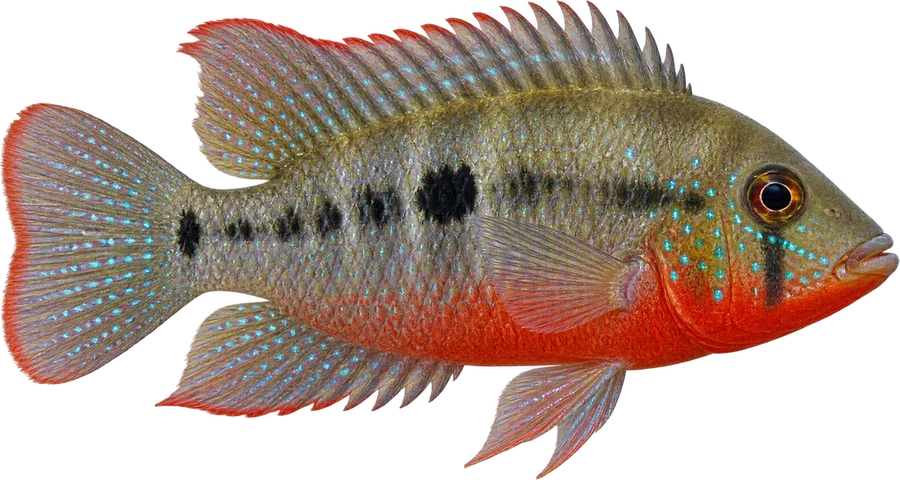
The firemouth is a medium-sized Central American cichlid with a gray-blue body and a bright red or orange throat and belly. When it feels threatened it flares its gills to show off that red, which makes it look bigger than it is. People want one because it has cichlid color and character without the size or the worst of the temper of its larger relatives.
- Grows to
- 6 in
- Smallest tank
- 29 gallons
- Temperature
- 75 to 86°F
- Water
- Fresh water
- Swims
- Low in the tank
- Buy together
- One is fine
- Lives
- 8 to 10 years
- With tank mates
- Eats small fish
Is it right for you?
Better with some experience. It is hardy and easy to feed, but it needs a long, established tank and its behavior changes when it breeds.
It is mild for a Central American cichlid and most of its aggression is gill flaring and bluff. It turns territorial when breeding and may eat very small fish.
What keepers say
Keepers are split on the firemouth. Many describe it as all show, with lots of gill flaring and little real damage, while others have owned an individual, usually a mature male, that attacked everything in the tank. The shared view is that it is one of the gentler Central American cichlids, but each fish needs watching.
What keepers like
- Keepers enjoy the gill-flaring display and the red throat that goes with it.
- Many keepers say their firemouths flare and push at each other without biting or injuring tank mates.
- Firemouths are reported to live peacefully for years with schooling fish and other mild cichlids.
- Keepers like the personality and find the fish busy and interesting to watch.
Good to know first
- Some keepers report a male that was peaceful when young and turned on its tank mates as it aged.
- A few keepers had an individual that picked fights with every fish, including larger cichlids, and had to be rehomed.
- Newly added fish are often the target of chasing.
- Keepers warn that once a pair breeds, other fish in a smaller tank get a hard time.
Tips keepers repeat
- Keepers suggest adding lots of wood, caves and other hiding places so each fish can claim its own spot.
- Rearranging the decorations when adding a new fish is a common way to reset territories.
- Keeping several firemouths together is said to keep the flaring between themselves instead of at other fish.
- Keepers advise buying cichlids young and adding them at the same time so they grow up together.
Summarised from keeper discussion on monsterfishkeepers.com, aquariacentral.com. Links are at the foot of the page.
What it needs
| Tank | 29 gallons or more. A male and female pair, or a group of 6 or more in a large tank. |
|---|---|
| Water | 75 to 86°F, pH 6.5 to 8. Fresh water. Needs a heater in most homes. |
| Food | It eats both meaty and plant foods and feeds mostly from the bottom. A quality cichlid pellet or flake with some plant content suits it, with frozen or live foods such as bloodworms and brine shrimp as extras. |
| Lifespan | 8 to 10 years with good care, so it is a long commitment. |
| Comes from | It comes from shallow, slow-moving rivers on the Atlantic side of Mexico's Yucatan Peninsula, Belize and northern Guatemala. |
One firemouth cichlid is fine on its own. Of the standard tank sizes, the 29, 40, 55, 75 and larger gallon tanks are big enough. Fish are counted at the size they grow to: a 6 inch adult takes far more room than the young fish in the store.
Who it can live with
Often kept with
- Swordtails, platies and mollies
- Blue acaras
- Severums
- Rainbowfish
- Bristlenose plecos
- Larger schooling tetras
Best kept apart from
- Very small fish such as neon tetras, because they may be eaten
- Shrimp and small snails, because they are treated as food
- Much larger or rougher cichlids, because the firemouth's bluff does not protect it in a real fight
- A breeding pair of convict cichlids, because the pair may attack or kill it
- African lake cichlids, because their water needs and aggression do not match
Against the other fish on this site
- Will eat: white cloud minnow, neon tetra, otocinclus catfish, cardinal tetra, ember tetra, galaxy rasbora, pygmy cory catfish, bumblebee goby, glowlight tetra, serpae tetra, black neon tetra, cherry shrimp. Anything that fits in its mouth is food.
- Chases and nips: guppy, angelfish.
- Gets nipped by: convict cichlid, jack dempsey.
- No clash on size or temperature: betta (male), oscar, bronze cory catfish, bristlenose pleco, black molly, sunburst platy, red swordtail, tiger barb, cherry barb, black skirt tetra, harlequin rasbora, dwarf gourami, kuhli loach, yellow lab cichlid, rainbow shark, bala shark, clown loach, endler livebearer, rummy nose tetra, congo tetra, pearl gourami, honey gourami, blue gourami, german blue ram, kribensis, discus, panda cory catfish, common pleco, siamese algae eater, boeseman's rainbowfish, pictus catfish, dalmatian molly, mystery snail.
That list is worked out from adult size and temperature alone. Individual fish vary, and a tank that is too small makes peaceful fish fight.
Where new owners go wrong
- Housing it with big, rough cichlids on the strength of the cichlid name, when it usually loses those fights.
- Choosing a tall, short tank, when this bottom-living fish needs floor space and length.
- Adding very small fish or shrimp and expecting them to be left alone.
- Not planning for the change in behavior when a pair forms and starts guarding eggs.
At the store
What to look for, and ask, before one goes in the bag.
- Young fish are pale, so look for a healthy shape and active behavior instead of strong red color.
- Avoid fish with clamped fins, sunken bellies or damaged fins.
- Check the label carefully, because similar-looking relatives are sometimes sold under the same name.
- Ask how big the fish gets and whether the store takes fish back if a pair becomes a problem.
What to buy for it
The smallest standard tank that suits it is the 29 gallon (30 x 12 x 18 inches), which weighs about 314 lb when full. It needs a heater in most homes. A real tank that is big enough: Aqueon 29 Gallon, 29 gallons, $129.99 on Amazon on 22 Nov 2026 (paid link). Heaters and filters are not linked to products yet.
Paid links: the stand names below link to Amazon and earn the site a commission.
| Stand that fits a 29 gallon | Top | Rated load | Price, 23 Nov 2026 |
|---|---|---|---|
| Bestier 20 to 37 gallon stand | 30.7 x 13.8 in | 400 lb | $71.39 |
| POKIPO 20 to 29 gallon stand, slide-out shelf | 31.5 x 15.8 in | 770 lb | $93.49 |
| TOCRETOARE 40 gallon metal stand | 36.5 x 18.5 in | 660 lb | $69.99 |
For the floor of the tank, sand and gravel shows how many pounds a 29 gallon takes. Stands compares every stand.
See it before you buy it
Put one firemouth cichlid in a tank that is big enough, add the fish you were thinking of keeping with it, and watch what the tank says about stocking, temperature and who gets along.
Sources
Checked on 23 November 2026. References disagree on how to keep it, with the same specialist source describing it as best in a pair and also as happiest in a group of 8 or more. Minimum tank size is given as about 30 gallons for a pair, as long as the tank is about 48 inches long, while keepers often recommend 55 gallons once other fish are added.
- Seriously Fish: Thorichthys meeki care reference
- Wikipedia: Firemouth cichlid care reference
- Aquarium Source: Firemouth cichlid care care reference
- Monster Fish Keepers forum thread on a firemouth in a community tank keeper discussion
- Monster Fish Keepers forum thread on firemouth aggression keeper discussion
- AquariaCentral forum thread on a companion for a firemouth keeper discussion
Care figures here come from the references listed and can still be wrong or out of date. Individual fish and tanks vary. Check with the store and a second care reference before you buy. Terms.