 Aquarium Fish Guide
Build a tank / Fish / Clown loach
Clown loach
Chromobotia macracanthus
The clown loach is a bright orange loach with three bold black bands and red fins, sold as a small juvenile in most fish stores. It is playful, social and long lived, which makes it a favorite. It also grows to about a foot long and needs a group, so it ends up needing one of the largest tanks of any common pet store fish.
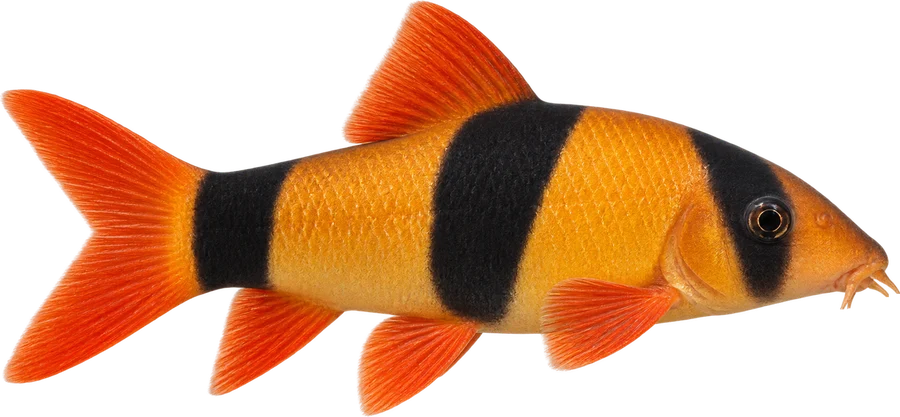
- Grows to
- 12 in
- Smallest tank
- 180 gallons
- Temperature
- 75 to 86°F
- Water
- Fresh water
- Swims
- On the bottom
- Buy together
- 6 or more
- Lives
- 20 to 30 years
- With tank mates
- Peaceful
Is it right for you?
For experienced keepers. It needs a very large tank, a group, warm and very clean water, and it catches ich easily.
It is peaceful and social, with harmless sparring inside the group, but it can nip slow, long-finned fish and may intimidate very small ones.
What keepers say
Keepers describe clown loaches as smart, entertaining fish that can live for decades, and many are strongly attached to theirs. The same keepers are blunt that they get big, need company and are quick to break out in ich when stressed. Opinions on how large a tank adults need range from about 110 gallons to well beyond a six foot tank.
What keepers like
- Keepers like that they are peaceful and get along in a wide range of community tanks.
- Keepers describe them as intelligent and fun to watch, especially in a large group.
- Keepers value that they eat almost anything, including pest snails.
- Keepers like that they can live for 20 years or more.
Good to know first
- A common complaint is ich, which often shows up after a move, a new addition or another stressful event.
- Keepers say fish from poorly kept store tanks often arrive already sick.
- Keepers report that small groups hide most of the time, especially under bright light.
- Keepers warn that they outgrow most home tanks, and many argue that even a six foot tank is tight for adults.
Tips keepers repeat
- Keepers say to keep the water very clean with frequent water changes.
- Keepers recommend plenty of caves and tubes, dim lighting and a fine, smooth substrate that is gentle on their barbels.
- Keepers advise quarantining new fish and watching closely for ich before adding them to the main tank.
- Keepers suggest going easy on medication doses and choosing milder treatments.
Summarised from keeper discussion on monsterfishkeepers.com, forums.loaches.com. Links are at the foot of the page.
What it needs
| Tank | 180 gallons or more. A group of 5 or 6 at the very least, and more is better. |
|---|---|
| Water | 75 to 86°F, pH 5 to 7. Fresh water. Needs a heater in most homes. |
| Food | It eats sinking pellets and frozen or live foods such as bloodworms and brine shrimp, along with some vegetables like blanched zucchini. It also eats snails. |
| Lifespan | 20 to 30 years with good care, so it is a long commitment. |
| Comes from | It comes from rivers on the Indonesian islands of Sumatra and Borneo. |
Clown loaches school. In ones and twos they hide and stress, so plan for six or more. Of the standard tank sizes, the 180, 240 gallon tanks are big enough. Fish are counted at the size they grow to: a 12 inch adult takes far more room than the young fish in the store.
Who it can live with
Often kept with
- Rainbowfish
- Congo tetras
- Tiger barbs
- Other botia loaches
- Larger peaceful catfish
Best kept apart from
- Bettas and fancy guppies, because their long fins may be nipped
- Pet snails such as mystery snails, because it eats snails
- Very small fish, which can be intimidated or eaten by adults
- Slow, long-finned cichlids such as angelfish, because of fin nipping
Against the other fish on this site
- Gets nipped by: rainbow shark.
- Wants different water temperature: white cloud minnow.
- No clash on size or temperature: neon tetra, guppy, betta (male), angelfish, oscar, bronze cory catfish, bristlenose pleco, black molly, sunburst platy, red swordtail, tiger barb, cherry barb, black skirt tetra, harlequin rasbora, dwarf gourami, kuhli loach, yellow lab cichlid, bala shark, otocinclus catfish, cardinal tetra, ember tetra, galaxy rasbora, endler livebearer, pygmy cory catfish, bumblebee goby, glowlight tetra, rummy nose tetra, serpae tetra, black neon tetra, congo tetra, pearl gourami, honey gourami, blue gourami, german blue ram, kribensis, convict cichlid, jack dempsey, firemouth cichlid, discus, panda cory catfish, common pleco, siamese algae eater, boeseman's rainbowfish, pictus catfish, dalmatian molly, cherry shrimp, mystery snail.
That list is worked out from adult size and temperature alone. Individual fish vary, and a tank that is too small makes peaceful fish fight.
Where new owners go wrong
- New owners often buy one or two small ones for a 20 or 30 gallon tank without knowing they grow to about a foot.
- New owners often keep a single fish, which leaves it stressed and hiding.
- New owners often skip quarantine and bring ich into the main tank.
- New owners often add them to a tank with pet snails, which get eaten.
At the store
What to look for, and ask, before one goes in the bag.
- Check every fish in the store tank for white spots, because ich is common in this species.
- Avoid thin fish with pinched bellies, since newly imported ones can suffer from a wasting condition.
- Ask whether the fish are eating and how long the store has had them.
- Be honest about the tank size at home, and ask whether the store takes back fish that outgrow it.
What to buy for it
The smallest standard tank that suits it is the 180 gallon (72 x 24 x 25 inches), which weighs about 1981 lb when full. It needs a heater in most homes. No real tank this large is listed here yet. Heaters and filters are not linked to products yet.
For the floor of the tank, sand and gravel shows how many pounds a 180 gallon takes. Stands compares every stand.
See it before you buy it
Put 6 clown loaches in a tank that is big enough, add the fish you were thinking of keeping with them, and watch what the tank says about stocking, temperature and who gets along.
Sources
Checked on 23 November 2026. References disagree widely on tank size: one says 55 gallons is enough for juveniles with an upgrade later, while another calls a 72 by 24 inch tank of about 170 gallons the absolute minimum for a group, and the larger figure is used here. Maximum size is quoted as anything from 6 to 8 inches for typical aquarium fish up to 16 inches, and the claim of a 30 year lifespan is disputed.
- Seriously Fish: Chromobotia macracanthus care reference
- Aquarium Co-Op: clown loach care guide care reference
- Wikipedia: Clown loach care reference
- Monster Fish Keepers thread on what to know about clown loaches keeper discussion
- Loaches Online forum thread on clown loach tank size keeper discussion
Care figures here come from the references listed and can still be wrong or out of date. Individual fish and tanks vary. Check with the store and a second care reference before you buy. Terms.