 Aquarium Fish Guide
Build a tank / Fish / Dalmatian molly
Dalmatian molly
Poecilia sphenops (a spotted color variety, often crossed with the sailfin molly, Poecilia latipinna)
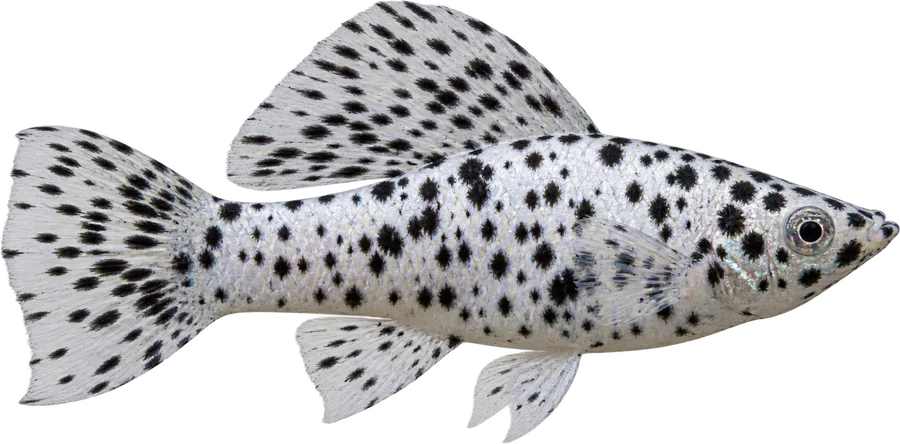
The dalmatian molly is a tank-bred color form of the molly, white or silver with black speckles like the dog it is named after. It is a livebearer, which means the females give birth to free-swimming babies instead of laying eggs. People want one because it is striking, active, widely sold and breeds without any help.
- Grows to
- 5 in
- Smallest tank
- 29 gallons
- Temperature
- 70 to 82°F
- Water
- Fresh water
- Swims
- The middle of the tank
- Buy together
- 3 or more
- Lives
- 3 to 5 years
- With tank mates
- Peaceful
Is it right for you?
Good for a first tank. It is easy in hard, alkaline, clean water, but it does poorly in soft water or in a new tank with any trace of ammonia.
It is active and usually peaceful, but males chase females constantly and some individuals nip or bully other fish. Adults also eat many of their own babies.
What keepers say
Keepers find dalmatian mollies beautiful and easy to breed, and more than a few are surprised by how pushy they can be. The other long-running topic is salt: many keepers have kept them for years in plain fresh water, especially hard water, while others find they are healthier and livelier with some salt.
What keepers like
- Keepers call dalmatians beautiful fish and admire the tall top fin on a good male.
- Keepers with hard tap water report keeping them for years in plain fresh water with no trouble.
- They breed readily, and babies are reported to grow quickly in a freshwater tank.
- Keepers describe them as bold, active fish that are always out in view.
Good to know first
- A common complaint is a male, or sometimes a female, that charges and nips tank mates, with some keepers returning the fish.
- Keepers say mollies kept without salt in softer water catch ich and fungus more easily.
- Store-bought mollies are often in poor shape, and clamped fins and shimmying on the spot are the usual signs.
- Adults eat many of the babies unless the young have cover or a separate tank.
Tips keepers repeat
- Keepers advise more females than males, and adding another female if one male is harassing the rest.
- A little salt is suggested for new or sick fish, and it is then removed gradually over about a week with water changes.
- Crushed coral or limestone-type rock is a common way to keep the water hard.
- Keepers recommend plenty of live plants and regular partial water changes, because mollies react badly to even small amounts of ammonia.
Summarised from keeper discussion on tfhmagazine.com, aquariacentral.com, fishprofiles.com. Links are at the foot of the page.
What it needs
| Tank | 29 gallons or more. A small group with two or three females for every male. |
|---|---|
| Water | 70 to 82°F, pH 7 to 8.5. Fresh water. |
| Food | It eats both plant and animal foods and needs plenty of greens. A vegetable-based flake or algae wafers with blanched spinach or similar vegetables, plus some frozen bloodworms or brine shrimp, covers its needs. |
| Lifespan | 3 to 5 years with good care, so it is a long commitment. |
| Comes from | It is a bred variety that does not exist in the wild; its wild ancestors live in fresh and slightly salty coastal waters from Mexico to Colombia and Venezuela. |
Dalmatian mollies are usually bought in a small group of about 3. Of the standard tank sizes, the 29, 40, 55, 75 and larger gallon tanks are big enough. Fish are counted at the size they grow to: a 5 inch adult takes far more room than the young fish in the store.
Who it can live with
Often kept with
- Platies
- Swordtails
- Guppies
- Other mollies of the same kind
- Rainbowfish
- Barbs and tetras that tolerate hard water
Best kept apart from
- Fish that need soft, acidic water, such as cardinal tetras and discus, because mollies need hard, alkaline water
- Slow, long-finned fish such as bettas and angelfish, because some mollies nip fins
- Large or aggressive cichlids, because they attack or eat mollies
- Sailfin mollies, if babies are wanted, because the two kinds crossbreed readily
Against the other fish on this site
- No clash on size or temperature: comet goldfish, fancy goldfish, rosy red minnow, white cloud minnow, neon tetra, zebra danio, guppy, betta (male), angelfish, oscar, bronze cory catfish, bristlenose pleco, black molly, sunburst platy, red swordtail, tiger barb, cherry barb, black skirt tetra, harlequin rasbora, dwarf gourami, kuhli loach, yellow lab cichlid, rainbow shark, bala shark, otocinclus catfish, clown loach, cardinal tetra, ember tetra, galaxy rasbora, endler livebearer, pygmy cory catfish, bumblebee goby, hillstream loach, glowlight tetra, rummy nose tetra, serpae tetra, black neon tetra, congo tetra, pearl gourami, honey gourami, blue gourami, kribensis, convict cichlid, jack dempsey, firemouth cichlid, discus, panda cory catfish, common pleco, siamese algae eater, pictus catfish, cherry shrimp, mystery snail.
That list is worked out from adult size and temperature alone. Individual fish vary, and a tank that is too small makes peaceful fish fight.
Where new owners go wrong
- Keeping it in soft, acidic water with fish such as neon tetras, where it slowly declines.
- Adding it to a brand new tank that has not finished cycling.
- Keeping one male with one female, or several males, so the females get no rest.
- Having no plan for the babies, which arrive every month or so.
At the store
What to look for, and ask, before one goes in the bag.
- Avoid fish that hold their fins clamped, rock from side to side on the spot or have white spots or fuzzy patches.
- Ask whether the store keeps its mollies in salted water, and if so, plan to get the fish used to the home tank slowly.
- Ask the store to pick two or three females for each male; males have a narrow, rod-shaped fin under the belly.
- Expect that any female sold from a mixed tank is probably already carrying babies.
What to buy for it
The smallest standard tank that suits it is the 29 gallon (30 x 12 x 18 inches), which weighs about 314 lb when full. It does not need a heater in a normally warm room. A real tank that is big enough: Aqueon 29 Gallon, 29 gallons, $129.99 on Amazon on 22 Nov 2026 (paid link). Heaters and filters are not linked to products yet.
Paid links: the stand names below link to Amazon and earn the site a commission.
| Stand that fits a 29 gallon | Top | Rated load | Price, 23 Nov 2026 |
|---|---|---|---|
| Bestier 20 to 37 gallon stand | 30.7 x 13.8 in | 400 lb | $71.39 |
| POKIPO 20 to 29 gallon stand, slide-out shelf | 31.5 x 15.8 in | 770 lb | $93.49 |
| TOCRETOARE 40 gallon metal stand | 36.5 x 18.5 in | 660 lb | $69.99 |
For the floor of the tank, sand and gravel shows how many pounds a 29 gallon takes. Stands compares every stand.
See it before you buy it
Put 3 dalmatian mollies in a tank that is big enough, add the fish you were thinking of keeping with them, and watch what the tank says about stocking, temperature and who gets along.
Sources
Checked on 23 November 2026. References disagree on which species the dalmatian molly belongs to, with one listing it under the common short-finned molly and another under the sailfin molly, and it is likely a cross of the two. Minimum tank size is given as about 20 gallons by one reference and 30 gallons by another, and the 30 gallon figure is used here. Adult size is given as about 3 inches by one reference and 3 to 5 inches by another, and keepers disagree on whether added salt is needed.
- Seriously Fish: Poecilia sphenops care reference
- Fishkeeping World: Dalmatian molly care guide care reference
- Tropical Fish Hobbyist article on fancy molly care and the salt myth keeper discussion
- AquariaCentral forum thread on keeping mollies with no salt keeper discussion
- FishProfiles forum thread on a dalmatian molly keeper discussion
- FishProfiles forum thread on male aggression in dalmatian mollies keeper discussion
Care figures here come from the references listed and can still be wrong or out of date. Individual fish and tanks vary. Check with the store and a second care reference before you buy. Terms.