 Aquarium Fish Guide
Build a tank / Fish / Pictus catfish
Pictus catfish
Pimelodus pictus
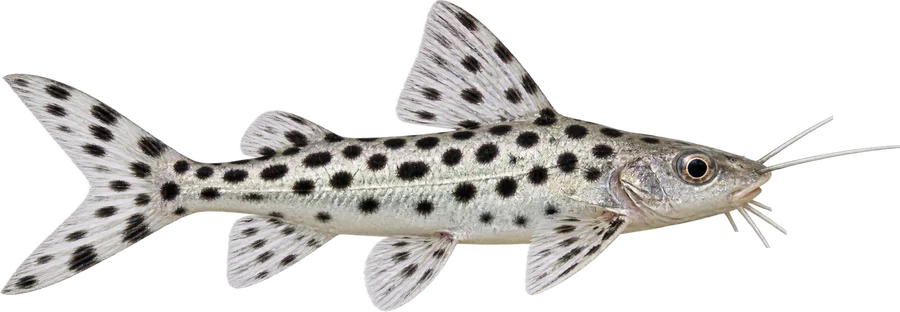
The pictus catfish is a sleek, silver catfish covered in black spots, with very long white whiskers that can reach back to its tail. It comes from the big rivers of South America and, unlike most catfish, it is a fast, restless swimmer that is often out in the open. People want it for its looks and energy, but it grows to about 5 inches and eats any fish small enough to swallow.
- Grows to
- 5 in
- Smallest tank
- 65 gallons
- Temperature
- 72 to 77°F
- Water
- Fresh water
- Swims
- Low in the tank
- Buy together
- 6 or more
- Lives
- 8 to 10 years
- With tank mates
- Eats small fish
Is it right for you?
Better with some experience. It needs a large tank and clean water, it eats small tank mates, and its scaleless skin makes it prone to ich and sensitive to medication.
It is not aggressive, but it is a predator that hunts small fish, mostly at night. Its speed and long whiskers can also bother slow or nervous tank mates.
What keepers say
Keepers call the pictus a gorgeous fish with a big personality and often the one visitors notice first. Their warnings are consistent: it clears out small fish, its fin spines are a hazard when it has to be moved, and treating it for ich takes care because it reacts badly to common medicines.
What keepers like
- Keepers describe pictus catfish as beautiful and say they draw more attention than any other fish in the tank.
- They are praised for personality and for being active and visible, unlike many catfish.
- Keepers enjoy the buzzing or croaking sounds the fish make when they squabble.
- The spotted kind stays a manageable 4 to 5 inches for most keepers.
Good to know first
- A common complaint is waking up to find a whole school of neon or glowlight tetras gone in one night.
- The sharp spines on the top and side fins tangle in nets, and keepers say a jab from one hurts a lot.
- Keepers report losing pictus catfish after dosing a standard ich medicine at full strength.
- A larger look-alike species is sometimes sold under the same name and grows to about 10 inches.
Tips keepers repeat
- Keepers recommend catching the fish with a plastic tub or cup instead of a net.
- For ich, many keepers prefer raised temperature and a little salt, and use medicine only at half dose.
- Catching ich at the first few spots is said to give a much better chance of saving the fish.
- Keepers advise choosing tank mates too big to fit in the catfish's mouth and expecting anything smaller to vanish.
Summarised from keeper discussion on monsterfishkeepers.com, aquariacentral.com. Links are at the foot of the page.
What it needs
| Tank | 65 gallons or more. A group of 5 or 6 or more; a single fish tends to hide all day. |
|---|---|
| Water | 72 to 77°F, pH 5.8 to 7.5. Fresh water. Needs a heater in most homes. |
| Food | It eats almost anything, including sinking pellets, bloodworms, earthworms, brine shrimp and prepared foods. It is greedy and overeats easily, so adults do not need large daily meals. |
| Lifespan | 8 to 10 years with good care, so it is a long commitment. |
| Comes from | It comes from the Amazon and Orinoco river basins in Colombia, Venezuela, Peru and Brazil. |
Pictus catfish school. In ones and twos they hide and stress, so plan for six or more. Of the standard tank sizes, the 75, 125, 180, 240 gallon tanks are big enough. Fish are counted at the size they grow to: a 5 inch adult takes far more room than the young fish in the store.
Who it can live with
Often kept with
- Rainbowfish
- Giant danios
- Larger tetras and barbs
- Medium-sized gouramis
- Plecos and other sturdy catfish
- Other pictus catfish
Best kept apart from
- Neon tetras, guppies and other small fish, because they are eaten, often overnight
- Shrimp, because they are treated as food
- Slow or shy fish, because its speed and whiskers stress them
- Large aggressive cichlids such as green terrors, because they attack or eat it
Against the other fish on this site
- Will eat: white cloud minnow, neon tetra, otocinclus catfish, cardinal tetra, ember tetra, galaxy rasbora, pygmy cory catfish, bumblebee goby, glowlight tetra, serpae tetra, black neon tetra, cherry shrimp. Anything that fits in its mouth is food.
- Wants different water temperature: angelfish, german blue ram, discus, boeseman's rainbowfish.
- No clash on size or temperature: comet goldfish, fancy goldfish, rosy red minnow, zebra danio, guppy, oscar, bronze cory catfish, bristlenose pleco, black molly, sunburst platy, red swordtail, tiger barb, cherry barb, black skirt tetra, harlequin rasbora, dwarf gourami, kuhli loach, yellow lab cichlid, rainbow shark, bala shark, clown loach, endler livebearer, hillstream loach, rummy nose tetra, congo tetra, honey gourami, blue gourami, kribensis, convict cichlid, jack dempsey, firemouth cichlid, panda cory catfish, common pleco, siamese algae eater, dalmatian molly, mystery snail.
That list is worked out from adult size and temperature alone. Individual fish vary, and a tank that is too small makes peaceful fish fight.
Where new owners go wrong
- Adding it to a community of neon tetras, guppies or other small fish.
- Keeping a single fish in a small tank, when it is a fast swimmer that prefers a group and plenty of room.
- Using full-strength ich medicine on a scaleless fish.
- Netting it and handling it by hand, which leads to a tangled fish and a painful jab.
At the store
What to look for, and ask, before one goes in the bag.
- Check that the long whiskers are complete and undamaged, because worn or missing whiskers point to dirty water.
- Look closely for tiny white spots on the body and fins, because this fish catches ich easily.
- Ask the store to bag it with a cup instead of a net and to double-bag it, because the spines can pierce plastic.
- Ask whether it is the small spotted pictus or a larger relative sold under the same name.
What to buy for it
The smallest standard tank that suits it is the 75 gallon (48 x 18 x 21 inches), which weighs about 827 lb when full. It needs a heater in most homes. No real tank this large is listed here yet. Heaters and filters are not linked to products yet.
Paid links: the stand names below link to Amazon and earn the site a commission.
| Stand that fits a 75 gallon | Top | Rated load | Price, 23 Nov 2026 |
|---|---|---|---|
| GRLEAF 55 to 75 gallon stand | 49 x 19 in | 1000 lb | $118.99 |
| HOOBRO 75 gallon stand, two drawers | 52 x 19.7 in | 1146 lb | $103.99 |
| VOWNER 125 to 150 gallon stand with cabinet | 72.9 x 18.9 in | 2200 lb | $223.99 |
For the floor of the tank, sand and gravel shows how many pounds a 75 gallon takes. Stands compares every stand.
See it before you buy it
Put 6 pictus catfish in a tank that is big enough, add the fish you were thinking of keeping with them, and watch what the tank says about stocking, temperature and who gets along.
Sources
Checked on 23 November 2026. One specialist reference says it should not be kept in a tank with a base smaller than 48 by 18 inches, which is about 65 gallons, and that figure is used here, while other guides accept 50 to 55 gallons. References also differ on water, with one giving a soft, acidic pH of 5.8 to 6.8 and cooler water of 72 to 77 degrees, and another giving pH 7 to 7.5 and up to 80 degrees.
- Seriously Fish: Pimelodus pictus care reference
- Wikipedia: Pimelodus pictus care reference
- Aquarium Source: Pictus catfish care care reference
- Monster Fish Keepers forum thread on pictus cats eating small fish keeper discussion
- Monster Fish Keepers forum thread on a pictus catfish with ich keeper discussion
- AquariaCentral forum thread on a pictus catfish lost after ich medication keeper discussion
Care figures here come from the references listed and can still be wrong or out of date. Individual fish and tanks vary. Check with the store and a second care reference before you buy. Terms.