 Aquarium Fish Guide
Build a tank / Fish / Neon tetra
Neon tetra
Paracheirodon innesi
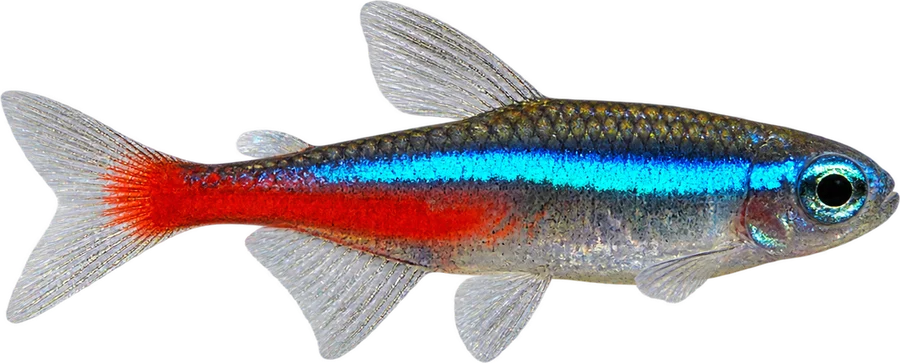
The neon tetra is a tiny South American schooling fish with a glowing blue stripe along its side and a red band toward the tail. A group moving together through a planted tank is one of the classic sights of the hobby, which is why it is among the most popular aquarium fish in the world. It is peaceful and cheap, but store-bought neons are more fragile than their reputation suggests.
- Grows to
- 1.5 in
- Smallest tank
- 10 gallons
- Temperature
- 70 to 77°F
- Water
- Fresh water
- Swims
- The middle of the tank
- Buy together
- 6 or more
- Lives
- 5 to 10 years
- With tank mates
- Peaceful
Is it right for you?
Better with some experience. It is easy to feed and house, but mass-bred stock is often weak and new fish are prone to early losses and to neon tetra disease.
It is peaceful and a little timid, and it feels safest in a good-sized group of its own kind.
What keepers say
Keepers love the look of a neon school but are divided on how tough the fish is. The common story is that a share of newly bought neons die in the first days or weeks, which keepers blame on mass breeding, rough shipping and disease, while fish that survive the start often live for years.
What keepers like
- Keepers praise the color and the way a group moves together.
- Keepers say that settled, healthy neons in a good-sized group stay hardy for years.
- Many keepers remember neons as one of their first fish and keep coming back to them.
- Keepers find the colors look best over a dark bottom with plants and driftwood.
Good to know first
- A common complaint is new fish dying one by one for no clear reason, even when water tests look fine.
- Keepers say today's neons are less robust than they used to be and suspect heavy inbreeding and poor rearing conditions.
- Neon tetra disease is widely feared because it has no reliable cure and can pass through a group.
- Some keepers give up on neons and switch to cardinal tetras, although opinions differ on which is hardier.
Tips keepers repeat
- Keepers repeat that new neons should be kept apart for about a month before joining an established tank.
- Buying a larger group is advised, since small groups seem more stressed and more prone to illness.
- Keepers warn against keeping them too warm and aim for the mid to high 70s Fahrenheit at most.
- Changing stores is suggested if batches from one seller keep failing, and a store with a return policy is preferred.
Summarised from keeper discussion on aquariacentral.com, monsterfishkeepers.com. Links are at the foot of the page.
What it needs
| Tank | 10 gallons or more. A school of at least 8 to 10. |
|---|---|
| Water | 70 to 77°F, pH 6 to 7. Fresh water. |
| Food | It eats small flakes or micro pellets as a staple, with live or frozen treats such as daphnia, brine shrimp and bloodworms. Food pieces need to be small enough for its tiny mouth. |
| Lifespan | 5 to 10 years with good care, so it is a long commitment. |
| Comes from | It comes from soft, acidic forest streams in the Amazon basin of Colombia, Brazil and Peru, although nearly all fish for sale are farm bred. |
Neon tetras school. In ones and twos they hide and stress, so plan for six or more. Of the standard tank sizes, the 10, 15, 20, 29 and larger gallon tanks are big enough. Fish are counted at the size they grow to: a 1.5 inch adult takes far more room than the young fish in the store.
Who it can live with
Often kept with
- Other small peaceful tetras, such as cardinal tetras
- Rasboras
- Corydoras catfish
- Small plecos such as the bristlenose, and otocinclus
- Dwarf gouramis
- Guppies and platies
Best kept apart from
- Any fish large enough to swallow them, including adult angelfish
- African cichlids, because they are aggressive and need hard alkaline water
- Bettas with a pushy temper, because some will chase or eat small tetras
Against the other fish on this site
- Gets eaten by: comet goldfish, fancy goldfish, angelfish, oscar, bala shark, convict cichlid, jack dempsey, firemouth cichlid, pictus catfish.
- Wants different water temperature: german blue ram, discus, boeseman's rainbowfish.
- No clash on size or temperature: rosy red minnow, white cloud minnow, zebra danio, guppy, bronze cory catfish, bristlenose pleco, black molly, sunburst platy, red swordtail, tiger barb, cherry barb, black skirt tetra, harlequin rasbora, dwarf gourami, kuhli loach, yellow lab cichlid, rainbow shark, otocinclus catfish, clown loach, cardinal tetra, ember tetra, galaxy rasbora, endler livebearer, pygmy cory catfish, bumblebee goby, hillstream loach, glowlight tetra, rummy nose tetra, serpae tetra, black neon tetra, congo tetra, honey gourami, blue gourami, kribensis, panda cory catfish, common pleco, siamese algae eater, dalmatian molly, cherry shrimp, mystery snail.
That list is worked out from adult size and temperature alone. Individual fish vary, and a tank that is too small makes peaceful fish fight.
Where new owners go wrong
- Adding neons to a brand new tank that has not finished cycling.
- Buying only three or four, when they need a proper school to feel secure.
- Putting new fish straight into the main tank without a quarantine period.
- Keeping them with larger fish that can eat them.
At the store
What to look for, and ask, before one goes in the bag.
- Choose from a tank where the fish hold together in a group and none hang apart from the others.
- Avoid fish with faded color, white patches on the body, a pinched belly or a bent spine.
- Ask where the fish were bred and how long the batch has been in the store, since quality differs a lot between suppliers.
- Ask about the store's water pH and its return policy for early losses.
What to buy for it
The smallest standard tank that suits it is the 10 gallon (20 x 10 x 12 inches), which weighs about 109 lb when full. It does not need a heater in a normally warm room. A real tank that is big enough: Aqueon 20 Gallon Long, 20 gallons, $99.99 on Amazon on 22 Nov 2026 (paid link). Heaters and filters are not linked to products yet.
Paid links: the stand names below link to Amazon and earn the site a commission.
| Stand that fits a 10 gallon | Top | Rated load | Price, 23 Nov 2026 |
|---|---|---|---|
| Snughome 10 to 20 gallon stand, two shelves | 24 x 11.8 in | 350 lb | $33.24 |
| MAHANCRIS 10 gallon stand with cabinet | 23.6 x 11.8 in | 450 lb | $53.99 |
| Bestier 20 to 37 gallon stand | 30.7 x 13.8 in | 400 lb | $71.39 |
For the floor of the tank, sand and gravel shows how many pounds a 10 gallon takes. Stands compares every stand.
See it before you buy it
Put 6 neon tetras in a tank that is big enough, add the fish you were thinking of keeping with them, and watch what the tank says about stocking, temperature and who gets along.
Sources
Checked on 23 November 2026. Minimum tank size is given as 10 gallons by one reference and as a 24 by 12 inch tank of about 14 gallons by another, so the larger figure is used here. Suggested school sizes range from 6 to 15, and one reference allows temperatures up to 81 degrees Fahrenheit while another stops at 77.
- Seriously Fish: Paracheirodon innesi care reference
- Aquarium Source: Neon tetra care care reference
- AquariaCentral forum thread on keeping neon tetras alive keeper discussion
- AquariaCentral forum thread on whether neon tetras are hardy keeper discussion
- Monster Fish Keepers forum thread on neon tetras dying one by one keeper discussion
Care figures here come from the references listed and can still be wrong or out of date. Individual fish and tanks vary. Check with the store and a second care reference before you buy. Terms.