 Aquarium Fish Guide
Build a tank / Fish / Honey gourami
Honey gourami
Trichogaster chuna
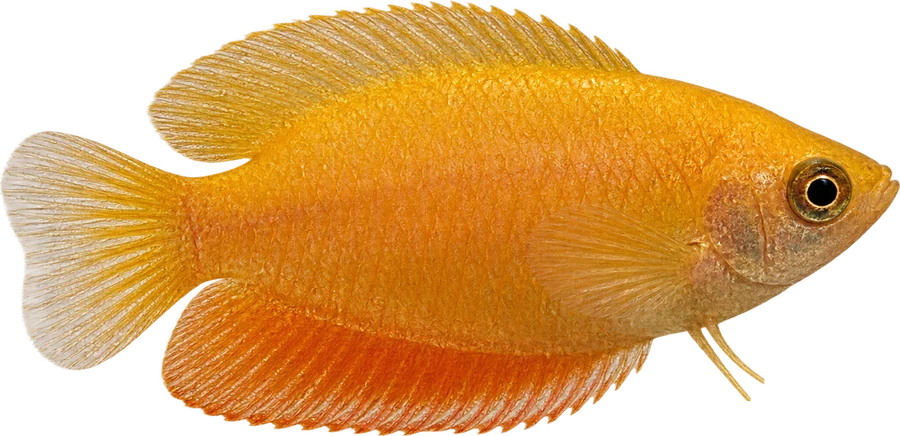
The honey gourami is a small, gentle gourami about 2 inches long, sold mostly in a yellow gold form and a red form often labeled sunset. Wild-colored males turn deep honey orange with a dark blue-black throat and belly when courting, while females stay silvery brown with a dark stripe. People choose it as a peaceful, slow-moving centerpiece fish for a small planted tank.
- Grows to
- 2 in
- Smallest tank
- 15 gallons
- Temperature
- 74 to 81°F
- Water
- Fresh water
- Swims
- Near the top
- Buy together
- One is fine
- Lives
- 5 to 8 years
- With tank mates
- Peaceful
Is it right for you?
Good for a first tank. It stays small, eats readily and tolerates a range of water, and it only needs calm tank mates and plenty of plant cover.
It is peaceful, slow and somewhat shy, and it is easily pushed off its food by bigger or livelier fish. Within a group the fish sort out a ranking, with some chasing at feeding time and between males.
What keepers say
Keepers describe honey gouramis as cute, mild fish that fit well in small community tanks. The recurring themes are shyness in new fish, confusion over what stores actually sell under the honey and sunset names, and the odd individual that turns bossy.
What keepers like
- Keepers call them one of the most peaceful gouramis and a favorite fish.
- Keepers like that they can be kept singly or in a small group.
- Keepers report they eat a wide range of foods, including flakes, small pellets, frozen bloodworms and brine shrimp.
- Some keepers find them longer lived and less prone to dying off than dwarf gouramis.
Good to know first
- A common complaint is a new fish hiding near the bottom and ignoring food for the first days.
- Keepers report that store names are unreliable, with fish labeled honey sunset sometimes turning out to be a different, larger or pushier gourami.
- Keepers note that keeping two together can lead to one bullying the other.
- Keepers say they get pushed around by bettas, cichlids and bigger gouramis.
Tips keepers repeat
- Keepers recommend plants and hiding spots, since the fish come out more when cover is close.
- Keepers suggest giving a new fish time to settle before worrying about its appetite.
- Keepers advise keeping either one fish or a proper group, since a pair often ends with one picked on.
- Keepers say to buy from a store that takes returns, because temperament varies between individuals.
Summarised from keeper discussion on aquariacentral.com. Links are at the foot of the page.
What it needs
| Tank | 15 gallons or more. One alone in a small tank, or a group of 3 to 6 in 20 gallons or more. |
|---|---|
| Water | 74 to 81°F, pH 6 to 7.5. Fresh water. Needs a heater in most homes. |
| Food | It is an omnivore that takes flakes, small pellets and frozen or freeze-dried foods from the surface and lower down. Small live or frozen foods such as daphnia, brine shrimp and bloodworms should be a regular part of the menu. |
| Lifespan | 5 to 8 years with good care, so it is a long commitment. |
| Comes from | It comes from still, weedy ponds, ditches and flooded fields in northern India, Bangladesh and Nepal. |
One honey gourami is fine on its own. Of the standard tank sizes, the 15, 20, 29, 40 and larger gallon tanks are big enough. Fish are counted at the size they grow to: a 2 inch adult takes far more room than the young fish in the store.
Who it can live with
Often kept with
- Ember tetras and other small peaceful tetras
- Small rasboras
- Corydoras catfish
- Kuhli loaches
- Adult cherry or amano shrimp
- Snails
Best kept apart from
- Dwarf gouramis, which tend to chase it
- Blue or opaline gouramis and cichlids, which bully it
- Aggressive bettas, because it will not defend itself
- Tiger barbs and other fin nippers, which go for its feelers
- Baby shrimp, which it will eat
Against the other fish on this site
- Gets eaten by: comet goldfish, fancy goldfish, oscar, bala shark, convict cichlid, jack dempsey.
- Gets nipped by: serpae tetra, blue gourami.
- Wants different water temperature: white cloud minnow, german blue ram.
- No clash on size or temperature: neon tetra, guppy, betta (male), angelfish, bronze cory catfish, bristlenose pleco, black molly, sunburst platy, red swordtail, tiger barb, cherry barb, black skirt tetra, harlequin rasbora, dwarf gourami, kuhli loach, yellow lab cichlid, rainbow shark, otocinclus catfish, clown loach, cardinal tetra, ember tetra, galaxy rasbora, endler livebearer, pygmy cory catfish, bumblebee goby, glowlight tetra, rummy nose tetra, black neon tetra, congo tetra, pearl gourami, kribensis, firemouth cichlid, discus, panda cory catfish, common pleco, siamese algae eater, pictus catfish, dalmatian molly, cherry shrimp, mystery snail.
That list is worked out from adult size and temperature alone. Individual fish vary, and a tank that is too small makes peaceful fish fight.
Where new owners go wrong
- New owners bring home a dwarf gourami or thick-lipped gourami sold under a honey or sunset label, and it grows bigger and more aggressive than expected.
- New owners keep it with a pushy tank boss, and the gourami spends its life hiding.
- New owners put two in a small tank and one ends up bullied.
- New owners pass over the plain females and young males in the store, not knowing they color up at home.
At the store
What to look for, and ask, before one goes in the bag.
- Confirm the scientific name, Trichogaster chuna, since dwarf gouramis reach about 3 inches and thick-lipped gouramis about 4.
- Ask which color form it is, because the red form is the one most often mixed up with the sunset thick-lipped gourami.
- Look for fish that are swimming in the open and feeding, with both feeler fins whole.
- Expect fish in a bare store tank to look pale, since color improves in a planted tank.
What to buy for it
The smallest standard tank that suits it is the 15 gallon (24 x 12 x 12 inches), which weighs about 160 lb when full. It needs a heater in most homes. A real tank that is big enough: Aqueon 20 Gallon Long, 20 gallons, $99.99 on Amazon on 22 Nov 2026 (paid link). Heaters and filters are not linked to products yet.
Paid links: the stand names below link to Amazon and earn the site a commission.
| Stand that fits a 15 gallon | Top | Rated load | Price, 23 Nov 2026 |
|---|---|---|---|
| Bestier 20 to 37 gallon stand | 30.7 x 13.8 in | 400 lb | $71.39 |
| POKIPO 20 to 29 gallon stand, slide-out shelf | 31.5 x 15.8 in | 770 lb | $93.49 |
| TOCRETOARE 40 gallon metal stand | 36.5 x 18.5 in | 660 lb | $69.99 |
For the floor of the tank, sand and gravel shows how many pounds a 15 gallon takes. Stands compares every stand.
See it before you buy it
Put one honey gourami in a tank that is big enough, add the fish you were thinking of keeping with it, and watch what the tank says about stocking, temperature and who gets along.
Sources
Checked on 23 November 2026. References disagree on tank size, from 10 gallons for a single fish to about 15 gallons for a pair and 20 gallons for a group of three. They also disagree on numbers, with some treating it as a group fish that needs four or more and others saying a single fish does fine alone. Lifespan is stated by only one reference, as 5 to 8 years.
- Seriously Fish: Trichogaster chuna care reference
- Aquarium Co-Op: honey gourami care guide care reference
- Wikipedia: Honey gourami care reference
- Aquarium Source: honey gourami care care reference
- Aquaria Central forum thread: Honey gourami keeper discussion
- Aquaria Central forum thread: Feeding Honey Gourami keeper discussion
- Aquaria Central forum thread: Honey Sunset Gourami, aggressive? keeper discussion
- Aquaria Central forum thread: Honey Sunset Gourami from Petsmart? keeper discussion
Care figures here come from the references listed and can still be wrong or out of date. Individual fish and tanks vary. Check with the store and a second care reference before you buy. Terms.