 Aquarium Fish Guide
Build a tank / Fish / Rummy nose tetra
Rummy nose tetra
Petitella bleheri
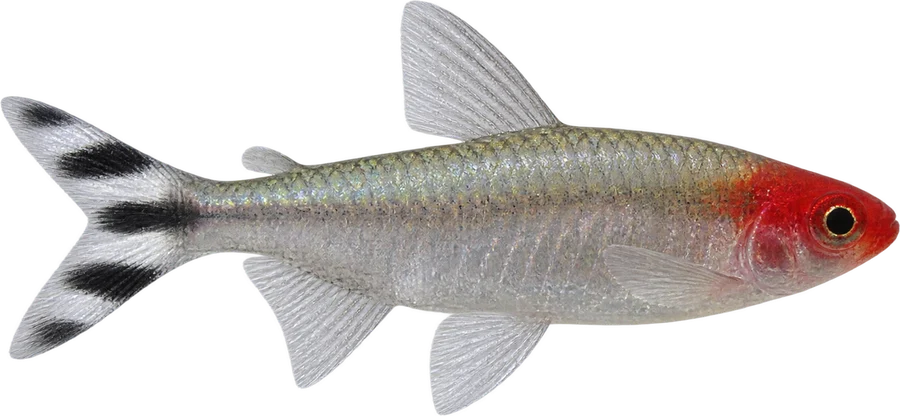
The rummy nose tetra is a slim silver tetra with a bright red head and a black and white striped tail. Three very similar species are sold under the name, and the one seen most often is the firehead tetra, formerly called Hemigrammus bleheri. People want it because it swims in one of the tightest schools of any aquarium fish, and because its red nose shows at a glance how the tank is doing.
- Grows to
- 2 in
- Smallest tank
- 29 gallons
- Temperature
- 74 to 79°F
- Water
- Fresh water
- Swims
- The middle of the tank
- Buy together
- 6 or more
- Lives
- 5 to 6 years
- With tank mates
- Peaceful
Is it right for you?
Better with some experience. It is sensitive to shipping, quick acclimation and poor water, even though it is steady once settled in a mature tank.
It is very peaceful and stays in a tight school. It does poorly with boisterous or much larger tank mates.
What keepers say
Keepers love the look of a rummy nose school and almost all of them warn that the first few weeks are the risky part. Reports of losing a large share of a new group soon after purchase are common, while fish that get through that stage are described as steady and long lasting.
What keepers like
- Keepers praise the tight schooling, which holds up better than with most tetras.
- Keepers like using the red nose as a quick check, since it glows when the fish are settled and fades when something is wrong.
- Keepers say the fish are not hard to care for once they are past acclimation.
- Keepers find them peaceful with cardinals, glowlights, neons and other calm fish.
Good to know first
- A common complaint is new fish dying within days of purchase, even when the water tests look normal.
- Keepers report that the fish react badly to sudden pH swings, salt and many chemical treatments.
- Keepers say quality varies a lot by supplier, with some batches arriving sick or carrying ich.
- Keepers note that small groups sulk in a corner with pale noses.
Tips keepers repeat
- Keepers recommend a slow drip acclimation over one to several hours instead of a quick float and release.
- Keepers advise quarantining new fish before they go into the main tank.
- Keepers suggest adding them only to a well established tank with stable water.
- Keepers say to compare the pH and hardness of the store's water with the home tank before buying.
Summarised from keeper discussion on monsterfishkeepers.com, aquariacentral.com. Links are at the foot of the page.
What it needs
| Tank | 29 gallons or more. A school of 10 or more. |
|---|---|
| Water | 74 to 79°F, pH 5.5 to 7. Fresh water. Needs a heater in most homes. |
| Food | It is an omnivore with a small mouth, so it needs small foods such as fine flakes, tiny pellets, daphnia and baby brine shrimp. A varied diet keeps the red head bright. |
| Lifespan | 5 to 6 years with good care, so it is a long commitment. |
| Comes from | It comes from soft, acidic, tea-colored rivers in the Rio Negro and Rio Meta basins of Brazil and Colombia. |
Rummy nose tetras school. In ones and twos they hide and stress, so plan for six or more. Of the standard tank sizes, the 29, 40, 55, 75 and larger gallon tanks are big enough. Fish are counted at the size they grow to: a 2 inch adult takes far more room than the young fish in the store.
Who it can live with
Often kept with
- Cardinal tetras and other peaceful tetras
- Corydoras catfish
- Pencilfish
- Dwarf cichlids such as rams and Apistogramma
- Small plecos
- Discus, which like the same warm water
Best kept apart from
- Large or predatory cichlids, which eat fish this size
- Boisterous fish such as tiger barbs, which stress it
- Goldfish and other cool water fish, which need lower temperatures
- Baby shrimp and fry, which it may eat
Against the other fish on this site
- Gets eaten by: comet goldfish, fancy goldfish, oscar, bala shark, convict cichlid, jack dempsey.
- Wants different water temperature: white cloud minnow, german blue ram, boeseman's rainbowfish.
- No clash on size or temperature: neon tetra, guppy, betta (male), bronze cory catfish, bristlenose pleco, black molly, sunburst platy, red swordtail, tiger barb, cherry barb, black skirt tetra, harlequin rasbora, dwarf gourami, kuhli loach, yellow lab cichlid, rainbow shark, otocinclus catfish, clown loach, cardinal tetra, ember tetra, galaxy rasbora, endler livebearer, pygmy cory catfish, bumblebee goby, glowlight tetra, serpae tetra, black neon tetra, congo tetra, pearl gourami, honey gourami, blue gourami, kribensis, firemouth cichlid, panda cory catfish, common pleco, siamese algae eater, pictus catfish, dalmatian molly, cherry shrimp, mystery snail.
That list is worked out from adult size and temperature alone. Individual fish vary, and a tank that is too small makes peaceful fish fight.
Where new owners go wrong
- New owners add them to a newly set up tank, where they are among the first fish to die.
- New owners float the bag for a few minutes and release the fish, which this species handles badly.
- New owners buy three or four, which leaves the fish stressed, pale and hiding.
- New owners treat a pale nose as a disease to medicate instead of checking water quality and temperature first.
At the store
What to look for, and ask, before one goes in the bag.
- Look for bright red noses, gently rounded bellies and active swimming, with no white spots.
- Ask how long the fish have been in the store, since a pale nose can simply mean a recent shipment.
- Ask what pH and hardness the store keeps them in, and whether they are tank raised or wild caught.
- Do not panic if the fish lie still in the bag on the way home, because they often play dead and recover once the bag is set down.
What to buy for it
The smallest standard tank that suits it is the 29 gallon (30 x 12 x 18 inches), which weighs about 314 lb when full. It needs a heater in most homes. A real tank that is big enough: Aqueon 29 Gallon, 29 gallons, $129.99 on Amazon on 22 Nov 2026 (paid link). Heaters and filters are not linked to products yet.
Paid links: the stand names below link to Amazon and earn the site a commission.
| Stand that fits a 29 gallon | Top | Rated load | Price, 23 Nov 2026 |
|---|---|---|---|
| Bestier 20 to 37 gallon stand | 30.7 x 13.8 in | 400 lb | $71.39 |
| POKIPO 20 to 29 gallon stand, slide-out shelf | 31.5 x 15.8 in | 770 lb | $93.49 |
| TOCRETOARE 40 gallon metal stand | 36.5 x 18.5 in | 660 lb | $69.99 |
For the floor of the tank, sand and gravel shows how many pounds a 29 gallon takes. Stands compares every stand.
See it before you buy it
Put 6 rummy nose tetras in a tank that is big enough, add the fish you were thinking of keeping with them, and watch what the tank says about stocking, temperature and who gets along.
Sources
Checked on 23 November 2026. References disagree on tank size, from 20 gallons up to a tank at least 36 inches long, so 30 gallons is given here. They also disagree on temperature, with the cautious range given here ending at 79 F while others say the fish handle the low to mid 80s, and on group size, from 6 up to 10 or more.
- Seriously Fish: Petitella bleheri (formerly Hemigrammus bleheri) care reference
- Aquarium Co-Op: rummy-nose tetra care guide care reference
- Wikipedia: Rummy-nose tetra care reference
- Monster Fish Keepers forum thread: Rummy Nose Tetras will be my demise keeper discussion
- Aquaria Central forum thread: Rummy nose tetra, delicate how? keeper discussion
- Aquaria Central forum thread: Rummynose Tetras dying keeper discussion
Care figures here come from the references listed and can still be wrong or out of date. Individual fish and tanks vary. Check with the store and a second care reference before you buy. Terms.