 Aquarium Fish Guide
Build a tank / Fish / Black molly
Black molly
Poecilia sphenops
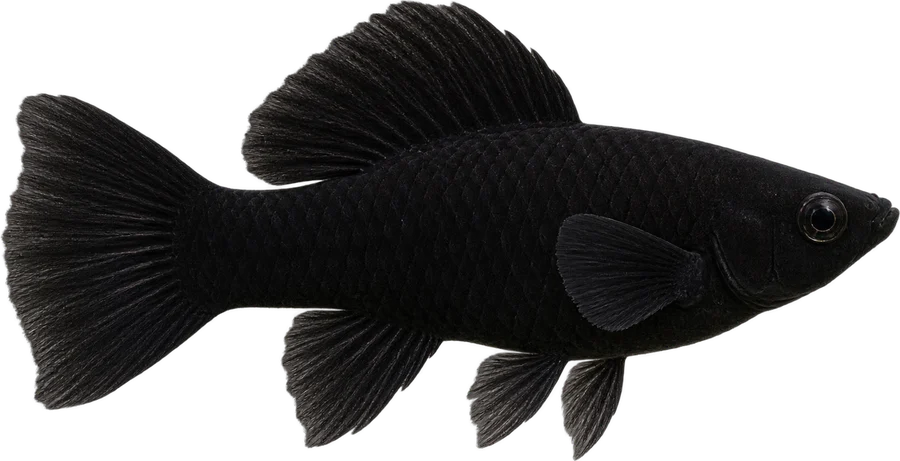
The black molly is an aquarium-bred, all-black form of the short-finned molly, a livebearer that gives birth to free-swimming babies instead of laying eggs. People buy it for the solid velvet-black color, which stands out against green plants and brighter fish. It is sold as a beginner fish, but it needs hard, mineral-rich water and a clean tank to stay healthy.
- Grows to
- 4.5 in
- Smallest tank
- 20 gallons
- Temperature
- 75 to 80°F
- Water
- Fresh water
- Swims
- The middle of the tank
- Buy together
- 3 or more
- Lives
- 3 to 5 years
- With tank mates
- Peaceful
Is it right for you?
Better with some experience. It is easy to feed and house, but the black strain is less sturdy than wild mollies and does poorly in soft water or in a tank with any ammonia.
It is peaceful with other fish, although it nibbles at things and males pester females constantly. Slow fish with long fins can get picked at.
What keepers say
Keepers are split on black mollies. Many keep them in plain fresh water for years without trouble, especially where the tap water is hard, while others find the black strain gets sick more easily than other mollies. The long-running argument is whether they need salt, and the more experienced view is that hard water and a clean tank matter more than salt does.
What keepers like
- Keepers with hard tap water report mollies living and breeding in plain fresh water with no problems.
- Keepers like that mollies graze on plants and algae between meals.
- Several keepers say their mollies became bolder and more active once the water suited them.
- Breeding takes no effort, so a group soon produces babies.
Good to know first
- A common complaint is that black mollies catch fungus and white spot more readily than other mollies.
- Keepers report clamped fins and a rocking, shimmying motion when even a little ammonia is present.
- Some keepers find their mollies stay nervous and hidden in soft fresh water even when test results look fine.
- Fish from pet stores are often described as arriving weak and going downhill within weeks.
Tips keepers repeat
- Keepers advise asking the seller what water the fish were kept in and then switching them over slowly.
- Experienced keepers treat salt as a short-term aid for a struggling fish and not as a cover for poor tank care.
- Keepers recommend crushed coral or a mineral supplement if the tap water is soft.
- Plenty of live plants and regular partial water changes are repeated as the way to keep ammonia at zero.
Summarised from keeper discussion on aquariacentral.com, tfhmagazine.com. Links are at the foot of the page.
What it needs
| Tank | 20 gallons or more. A small group with 2 or 3 females for every male. |
|---|---|
| Water | 75 to 80°F, pH 7 to 8.5. Fresh water. Needs a heater in most homes. |
| Food | It is an omnivore that takes flakes, pellets and frozen foods, but a good share of the diet should be plant based, such as vegetable flakes, algae wafers or blanched spinach. |
| Lifespan | 3 to 5 years with good care, so it is a long commitment. |
| Comes from | The wild short-finned molly lives from Mexico through Central America to Colombia and Venezuela, while the black form was developed in captivity. |
Black mollies are usually bought in a small group of about 3. Of the standard tank sizes, the 20, 29, 40, 55 and larger gallon tanks are big enough. Fish are counted at the size they grow to: a 4.5 inch adult takes far more room than the young fish in the store.
Who it can live with
Often kept with
- Platies
- Swordtails
- Corydoras catfish
- Danios
- Hard-water rainbowfish
- Other mollies
Best kept apart from
- Long-finned bettas, because mollies nibble at trailing fins
- Soft-water fish such as cardinal tetras, because the two need opposite water
- Cherry shrimp, because larger mollies may eat them
- Large aggressive cichlids, because they bully or eat mollies
Against the other fish on this site
- Gets eaten by: oscar.
- Wants different water temperature: white cloud minnow, german blue ram, boeseman's rainbowfish.
- No clash on size or temperature: neon tetra, guppy, betta (male), angelfish, bronze cory catfish, bristlenose pleco, sunburst platy, red swordtail, tiger barb, cherry barb, black skirt tetra, harlequin rasbora, dwarf gourami, kuhli loach, yellow lab cichlid, rainbow shark, bala shark, otocinclus catfish, clown loach, cardinal tetra, ember tetra, galaxy rasbora, endler livebearer, pygmy cory catfish, bumblebee goby, glowlight tetra, rummy nose tetra, serpae tetra, black neon tetra, congo tetra, pearl gourami, honey gourami, blue gourami, kribensis, convict cichlid, jack dempsey, firemouth cichlid, panda cory catfish, common pleco, siamese algae eater, pictus catfish, dalmatian molly, cherry shrimp, mystery snail.
That list is worked out from adult size and temperature alone. Individual fish vary, and a tank that is too small makes peaceful fish fight.
Where new owners go wrong
- New owners put mollies in soft, acidic water with tetras, where the mollies slowly decline.
- New owners add mollies to a brand new tank before the filter can handle ammonia, which mollies tolerate very badly.
- New owners buy one male and one female, so the single female is chased without a break.
- New owners choose a 10 gallon tank and do not plan for adult size, heavy waste and a steady supply of babies.
At the store
What to look for, and ask, before one goes in the bag.
- Look for fish that swim with fins held open, and skip any that rock in place or keep their fins clamped.
- Check the black body for white spots, gray film or cottony tufts, which show up clearly on this color.
- Ask whether the store keeps its mollies in salted or hard water so the home tank can be matched to it.
- Ask for more females than males, and learn the difference: males have a thin rod-shaped fin under the belly and females have a fan-shaped one.
What to buy for it
The smallest standard tank that suits it is the 20 gallon (24 x 12 x 16 inches), which weighs about 211 lb when full. It needs a heater in most homes. A real tank that is big enough: Aqueon 20 Gallon Long, 20 gallons, $99.99 on Amazon on 22 Nov 2026 (paid link). Heaters and filters are not linked to products yet.
Paid links: the stand names below link to Amazon and earn the site a commission.
| Stand that fits a 20 gallon | Top | Rated load | Price, 23 Nov 2026 |
|---|---|---|---|
| Bestier 20 to 37 gallon stand | 30.7 x 13.8 in | 400 lb | $71.39 |
| POKIPO 20 to 29 gallon stand, slide-out shelf | 31.5 x 15.8 in | 770 lb | $93.49 |
| TOCRETOARE 40 gallon metal stand | 36.5 x 18.5 in | 660 lb | $69.99 |
For the floor of the tank, sand and gravel shows how many pounds a 20 gallon takes. Stands compares every stand.
See it before you buy it
Put 3 black mollies in a tank that is big enough, add the fish you were thinking of keeping with them, and watch what the tank says about stocking, temperature and who gets along.
Sources
Checked on 23 November 2026. References give minimum tank sizes from 10 to about 21 gallons, and the figure here follows the cautious end, with a tank about 3 feet long being better still. They also disagree on salt: care references say minerals matter and salt is optional, while some keepers add salt as routine.
- Seriously Fish: Poecilia sphenops care reference
- Aquarium Co-Op: Care Guide for Mollies care reference
- Fishkeeping World: Molly Fish care care reference
- Aquaria Central forum thread: Mollies with no salt? keeper discussion
- Tropical Fish Hobbyist: The Fancy Molly, Part 2, Proper Care and the Salt Myth keeper discussion
Care figures here come from the references listed and can still be wrong or out of date. Individual fish and tanks vary. Check with the store and a second care reference before you buy. Terms.