 Aquarium Fish Guide
Build a tank / Fish / Angelfish
Angelfish
Pterophyllum scalare
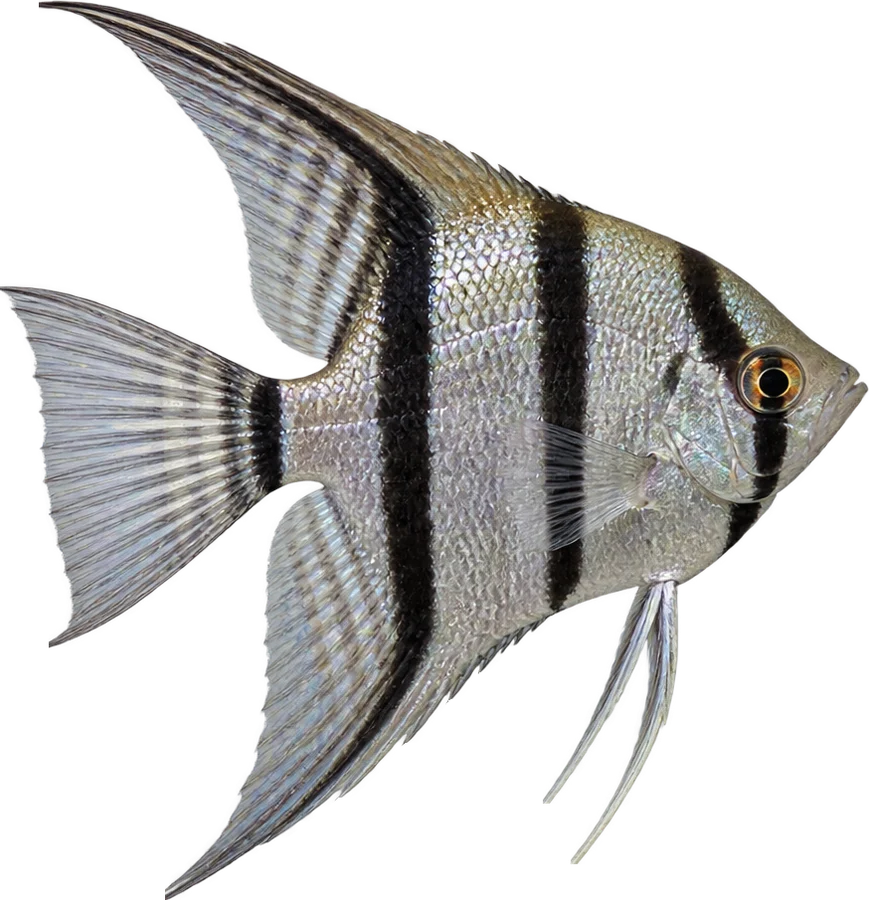
The freshwater angelfish is a South American cichlid with a flat, disc-shaped body and long fins that make it taller than it is long. An adult is about 6 inches long and 8 inches or more from fin tip to fin tip, and it comes in silver, black, gold, marble and koi patterns. People want one as a graceful centerpiece fish that learns to recognize whoever feeds it.
- Grows to
- 6 in
- Smallest tank
- 55 gallons
- Temperature
- 78 to 84°F
- Water
- Fresh water
- Swims
- The middle of the tank
- Buy together
- One is fine
- Lives
- 8 to 12 years
- With tank mates
- Eats small fish
Is it right for you?
Better with some experience. It needs a tall, roomy, warm tank and careful choice of tank mates, and its behavior can change sharply once two fish pair up.
It is fairly peaceful for a cichlid but squabbles with its own kind and becomes territorial when a pair forms and spawns. It will eat any fish small enough to fit in its mouth.
What keepers say
Keepers see angelfish as beautiful but less of a community fish than stores suggest. Experiences with small tank mates are split, with some keepers reporting years of peace and others watching small tetras vanish, and the common thread is that individual fish differ and that pairing changes everything.
What keepers like
- Keepers value angelfish as a showpiece for a large planted tank.
- Some keepers report angelfish living with small tetras for long periods without trouble, especially in heavily planted tanks.
- Pairs spawn readily in a home tank, which keepers find interesting to watch.
- Keepers find that a single angelfish can be a calm centerpiece fish.
Good to know first
- A common complaint is that stores label angelfish as community fish without warning that they eat small tank mates.
- Keepers report a long-peaceful angelfish suddenly attacking its companions, often when a pair forms.
- Healthy stock can be hard to find, and keepers blame poor-quality fish for unexplained losses.
- Pairs often eat their first batches of eggs.
Tips keepers repeat
- Keepers advise heavy planting and a large tank to give smaller fish cover and break up lines of sight.
- Choosing larger tetras over neons is widely suggested, with the warning to expect some losses anyway.
- Keepers recommend asking where a store's angelfish come from and favoring local breeders.
- Having a spare tank ready is advised so an aggressive fish or a spawning pair can be moved out.
Summarised from keeper discussion on aquariacentral.com, monsterfishkeepers.com. Links are at the foot of the page.
What it needs
| Tank | 55 gallons or more. One on its own, a bonded pair, or a group of 5 or 6 raised together in a large tank. |
|---|---|
| Water | 78 to 84°F, pH 6 to 7.5. Fresh water. Needs a heater in most homes. |
| Food | It eats flakes and pellets and prefers frozen or live foods such as bloodworms and brine shrimp. Keeping it well fed lowers the chance that it hunts smaller tank mates. |
| Lifespan | 8 to 12 years with good care, so it is a long commitment. |
| Comes from | It comes from slow rivers in the Amazon region of northern South America, including Brazil, Peru, Colombia and the Guianas, although nearly all fish for sale are farm bred. |
One angelfish is fine on its own. Of the standard tank sizes, the 55, 75, 125, 180 and larger gallon tanks are big enough. Fish are counted at the size they grow to: a 6 inch adult takes far more room than the young fish in the store.
Who it can live with
Often kept with
- Corydoras catfish
- Black skirt tetras and other deep-bodied tetras
- Adult cardinal tetras
- Bristlenose plecos
- Larger peaceful livebearers such as platies and swordtails
Best kept apart from
- Neon tetras and other very small fish, because grown angelfish often eat them
- Tiger barbs and other fin nippers, because they bite the long trailing fins
- Small shrimp, because they are eaten
- Fast, greedy fish, because they beat the angelfish to the food
- Bettas, because angelfish may attack them
Against the other fish on this site
- Will eat: white cloud minnow, neon tetra, otocinclus catfish, cardinal tetra, ember tetra, galaxy rasbora, pygmy cory catfish, bumblebee goby, glowlight tetra, serpae tetra, black neon tetra, cherry shrimp. Anything that fits in its mouth is food.
- Gets nipped by: tiger barb, black skirt tetra, yellow lab cichlid, serpae tetra, convict cichlid, jack dempsey, firemouth cichlid.
- Wants different water temperature: comet goldfish, fancy goldfish, rosy red minnow, zebra danio, hillstream loach, panda cory catfish, pictus catfish.
- No clash on size or temperature: guppy, betta (male), oscar, bronze cory catfish, bristlenose pleco, black molly, red swordtail, cherry barb, harlequin rasbora, dwarf gourami, bala shark, clown loach, endler livebearer, congo tetra, pearl gourami, honey gourami, blue gourami, german blue ram, discus, common pleco, boeseman's rainbowfish, dalmatian molly.
That list is worked out from adult size and temperature alone. Individual fish vary, and a tank that is too small makes peaceful fish fight.
Where new owners go wrong
- Buying small juveniles for a small tank without planning for a fish 8 inches tall.
- Keeping them with neon tetras or other tiny fish and expecting those fish to stay safe.
- Being unprepared for two fish pairing up, after which the pair may turn on its tank mates.
- Choosing a short tank, when adults need a tank at least 20 inches tall.
At the store
What to look for, and ask, before one goes in the bag.
- Choose young fish about the size of a quarter with a thick head and a meaty body, and pass on thin ones.
- Ask the store to feed them and pick the fish that eat eagerly.
- Avoid fish with cloudy or damaged eyes or torn, clamped fins.
- Ask whether the fish come from a local breeder or a bulk supplier.
What to buy for it
The smallest standard tank that suits it is the 55 gallon (48 x 13 x 21 inches), which weighs about 587 lb when full. It needs a heater in most homes. No real tank this large is listed here yet. Heaters and filters are not linked to products yet.
Paid links: the stand names below link to Amazon and earn the site a commission.
| Stand that fits a 55 gallon | Top | Rated load | Price, 23 Nov 2026 |
|---|---|---|---|
| METYERRY 55 gallon stand | 48.6 x 13.6 in | 860 lb | $95.99 |
| GRLEAF 55 to 75 gallon stand | 49 x 19 in | 1000 lb | $118.99 |
| HOOBRO 75 gallon stand, two drawers | 52 x 19.7 in | 1146 lb | $103.99 |
For the floor of the tank, sand and gravel shows how many pounds a 55 gallon takes. Stands compares every stand.
See it before you buy it
Put one angelfish in a tank that is big enough, add the fish you were thinking of keeping with it, and watch what the tank says about stocking, temperature and who gets along.
Sources
Checked on 23 November 2026. One guide allows up to four adults in a 29 gallon community tank, while another asks for a tank of about 53 gallons and at least 20 inches tall; the larger figure is used here. Recommended temperatures start at 75 degrees Fahrenheit in one reference and 78 in another.
- Seriously Fish: Pterophyllum scalare care reference
- Aquarium Co-Op: Care guide for freshwater angelfish care reference
- AquariaCentral forum thread on angelfish aggression keeper discussion
- AquariaCentral forum thread on angelfish with neon tetras keeper discussion
- Monster Fish Keepers forum thread on sudden angelfish aggression keeper discussion
- Monster Fish Keepers forum write-up on good and bad beginner fish keeper discussion
Care figures here come from the references listed and can still be wrong or out of date. Individual fish and tanks vary. Check with the store and a second care reference before you buy. Terms.