 Aquarium Fish Guide
Build a tank / Fish / Shubunkin
Shubunkin
Carassius auratus
Also known as: Harlequin goldfish, Calico shubunkin
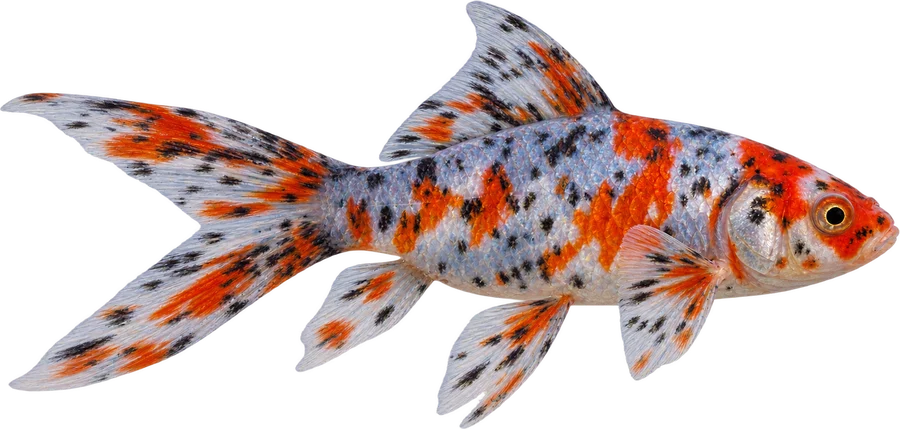
The shubunkin is a hardy single-tailed goldfish with a calico pattern: patches of red, orange, white, black and blue, often with dark speckles, on pearly scales that let the colors show through. Blue is the most prized color, and the three main types are the slim, fork-tailed American, the stockier, short-finned London and the rare Bristol with its large, rounded tail. It grows to about a foot long and is one of the best goldfish for an outdoor pond.
- Adult size
- 12 in
- Tank size
- 75 gallons or more
- Temperature
- 65 to 72°F
- Water
- Fresh water
- Swims
- The middle of the tank
- Group size
- One is fine
- Lifespan
- 10 to 15 years
- Temperament
- Eats small fish
Is a shubunkin right for you?
Better with some experience. It is hardy and easy to feed, but it grows to about a foot long, so it needs a pond or a very large, well-filtered tank.
It is peaceful, social and active. Its main fault is speed at feeding time, so slow fish kept with it can miss out.
What keepers say
Keepers treat the shubunkin as a pond goldfish that can spend its early years in a large tank. Fish of 10 to 12 inches are reported, and the usual plan is to move them outdoors as they grow. Many keepers bring pond fish indoors to a cool basement tub in places where the pond freezes solid.
What keepers like
- Shubunkins are tough and do well outdoors with comets, commons and koi.
- A grown shubunkin reaches a good size, with fish of around 12 inches reported.
- Young fish change color as they grow, so the final pattern can surprise you.
- Their slim body and short fins make them less of a target for nippy tank mates than long-finned fancy goldfish.
Good to know first
- Shubunkins outgrow most home tanks and look cramped in them once grown.
- Shubunkins in local stores are sometimes poorly colored, so a good fish can be hard to find.
- Large shubunkins may eat small companion fish such as white cloud minnows.
- Pushing growth with heavy feeding can backfire and cost the fish its life.
Tips keepers repeat
- Raise young shubunkins in a large tank and move them to a pond of a few hundred gallons as they grow.
- Frequent water changes do more for healthy growth than extra food.
- Where ponds freeze solid, a pool or stock tank in a cold basement, kept below about 50 degrees Fahrenheit, can hold the fish for winter with very little food.
- Keep the filter media wet and running between the pond and the winter container so the helpful bacteria survive.
Summarised from keeper discussion on monsterfishkeepers.com, aquariacentral.com. Links are at the foot of the page.
Shubunkin tank size and water
| Tank | 75 gallons or more. Social and best with other single-tailed goldfish; plan 75 gallons for the first fish and about 50 more gallons for each extra fish, as for a comet, or a pond. |
|---|---|
| Water | 65 to 72°F, pH 6.8 to 7.2. Fresh water. does not need a heater at ordinary room temperature. |
| Food | It is an omnivore that eats quality goldfish pellets or flakes, with treats such as bloodworms, brine shrimp and daphnia. Feed only what it finishes in a few minutes, and use a lower-protein food for pond fish as the water cools in autumn. |
| Lifespan | 10 to 15 years with good care, so it is a long commitment. |
| Comes from | It does not live in the wild; it was bred in Japan around 1900 by crossing calico telescope-eyed goldfish with comet and common goldfish. |
One shubunkin is fine on its own. Of the standard tank sizes, the 75, 125, 180, 240 gallon tanks are big enough. Those sizes are for the grown fish: a 12 inch adult takes far more room than the young fish in the store.
Shubunkin tank mates
Often kept with
- Other shubunkins
- Comet goldfish
- Common goldfish
- Koi, in a large pond
- White cloud mountain minnows, in a group, while the goldfish are still small enough not to eat them
- Longfin rosy barbs
Best kept apart from
- Fancy goldfish, because shubunkins are faster and take most of the food
- Tropical fish that need warm water, because shubunkins do best in cool water
- Small fish that fit in its mouth, because grown shubunkins may eat them
- Aggressive barbs and cichlids, which bully goldfish
Against the other fish on this site
- Will eat: rosy red minnow, white cloud minnow, neon tetra, zebra danio, guppy, betta (male), bronze cory catfish, zebra pleco, sunburst platy, tiger barb, cherry barb, black skirt tetra, harlequin rasbora, dwarf gourami, otocinclus catfish, cardinal tetra, ember tetra, galaxy rasbora, Endler livebearer, pygmy cory catfish, bumblebee goby, hillstream loach, glowlight tetra, rummy nose tetra, serpae tetra, black neon tetra, Congo tetra, honey gourami, German blue ram, panda cory catfish, cherry shrimp. Anything that fits in its mouth is food.
- Wants different water temperature: angelfish, oscar, bristlenose pleco, clown pleco, royal pleco, gold nugget pleco, sailfin pleco, black molly, kuhli loach, yellow lab cichlid, clown loach, pearl gourami, blue gourami, kribensis, convict cichlid, firemouth cichlid, discus, Siamese algae eater, Boeseman's rainbowfish.
- Named under “Best kept apart from” above: comet goldfish, fancy goldfish, common goldfish, fantail goldfish, pearlscale goldfish, bubble eye goldfish, celestial eye goldfish, veiltail goldfish.
No clash on size or temperature (8)
- Oranda goldfish
- Ryukin goldfish
- Black moor goldfish
- Ranchu and lionhead goldfish
- Rubber lip pleco
- Red swordtail
- Dalmatian molly
- Mystery snail
That list is worked out from adult size and temperature alone. Individual fish vary, and a tank that is too small makes peaceful fish fight.
Mistakes new owners make
- Putting a small shubunkin in a bowl or starter tank without planning for a fish about a foot long.
- Mixing shubunkins with slow fancy goldfish, which then go hungry.
- Overfeeding, which fouls the water and leads to sickness such as fin rot and swim bladder trouble.
- Filling the tank with decor and loose plants, which takes away swimming room and gets uprooted.
Buying shubunkins at the store
What to look for, and ask, before one goes in the bag.
- Look for a calico fish with matte, pearly scales and some blue, which is the most prized color.
- Remember that young fish can take months to show their full color, so a pale youngster may still develop.
- Check the tail shape to know which type you are buying: long and forked for an American, short and rounded for a London, large and broad for a Bristol.
- Avoid fish with clamped fins, white spots, sores, a swollen belly or odd swimming.
What to buy for a shubunkin
By volume, the smallest standard tank that suits it is the 75 gallon (48 x 18 x 21 inches); check that its footprint and height suit a grown shubunkin too. Full, it weighs about 827 lb. It does not need a heater at ordinary room temperature. No real tank this large is listed here yet. Heaters and filters are not linked to products yet.
Paid links: the stand names below earn the site a commission.
| Stand that fits a 75 gallon | Top | Rated load | Price |
|---|---|---|---|
| GRLEAF 55 to 75 gallon stand | 49 x 19 in | 1000 lb | |
| HOOBRO 75 gallon stand, two drawers | 52 x 19.7 in | 1146 lb | |
| VOWNER 125 to 150 gallon stand with cabinet | 72.9 x 18.9 in | 2200 lb |
For the floor of the tank, sand and gravel shows how many pounds a 75 gallon takes. Stands compares every stand.
Similar fish
 Comet goldfish12 in, 75 gallons or more
 Common goldfish12 in, 75 gallons or more
- All goldfish typesSingle-tailed and fancy goldfish compared
See it before you buy it
Put one shubunkin in a tank that is big enough, add the fish you were thinking of keeping with it, and watch what the tank says about stocking, temperature and who gets along.
Sources
Checked by Ishan on 23 November 2026. Published sizes run from 5 to 6 inches in a tank to 12 to 18 inches in a pond, so 12 inches is used here as in the goldfish hub. Tank advice ranges from 15 gallons as a bare minimum to 75 gallons for one fish and 180 gallons for a pond; the figure here takes 75 gallons. One reference gives 65 to 72 degrees Fahrenheit while the hub uses 65 to 75, and the narrower range is used here. pH is given as 6.8 to 7.2, 6.0 to 8.0 or 7.0 to 8.0 depending on the reference. Lifespan is 10 to 15 years in two references and more than 20 in another, against 10 to 20 in the hub. Most references place the origin in Japan around 1900, but one says China and another says the fish was developed more than 200 years ago.
- Wikipedia: Shubunkin care reference
- Aquarium Source: Shubunkin goldfish care guide care reference
- Fishkeeper: Shubunkin care care reference
- LiveAquaria: Shubunkin listing and quick stats care reference
- Aquarium Source: Comet goldfish care guide (single-tailed tank sizing) care reference
- Fishkeeping World: Types of goldfish care reference
- Aquarium Co-Op: Goldfish tank mates care reference
- Petco: Shubunkin goldfish listing (small) care reference
- Monster Fish Keepers thread: How big is your shubunkin? keeper discussion
- Monster Fish Keepers thread on a growing shubunkin and pond plans keeper discussion
- AquariaCentral thread: The rescued goldfish build keeper discussion
- AquariaCentral thread: White cloud minnows with shubunkin goldfish keeper discussion
- Monster Fish Keepers thread: Goldfish in a koi pond keeper discussion
- Wikipedia: Calico (goldfish) other names
- Aquatic Arts: Calico Shubunkin Goldfish other names
Care figures here come from the references listed and can still be wrong or out of date. Individual fish and tanks vary. Check with the store and a second care reference before you buy. Terms.